





Artificial intelligence is moving from experimentation into mainstream business operations across Asia Pacific, but the region’s ability to capture its benefits will depend less on access to technology than on workforce confidence, organisational culture and the quality of reskilling.
Evidence from recent Statista surveys points to a growing tension. Employees and businesses are adopting AI at speed, yet many workers remain uncertain about how the technology will affect jobs, careers and workplace expectations.
In an international Pew Research Center survey of 37 countries, people in 34 said they were more likely to expect AI to reduce jobs rather than create them over the next 20 years. These concerns were particularly strong in wealthier economies, where awareness of AI is generally higher.
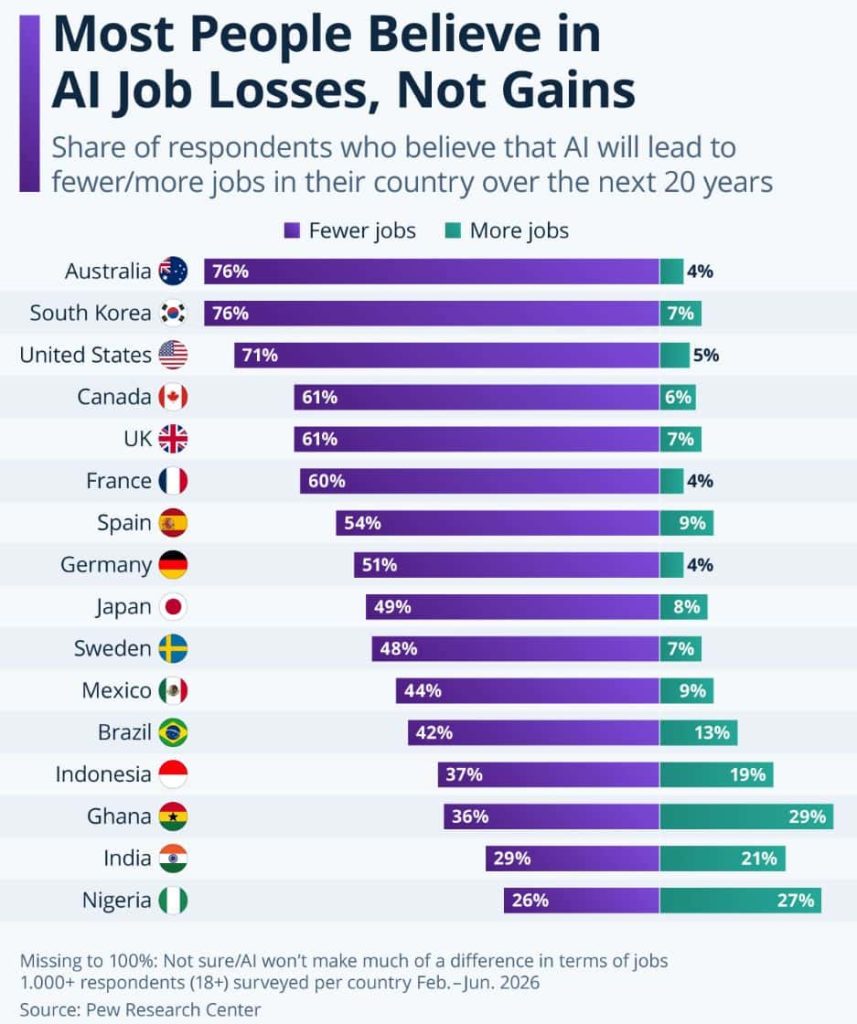
The gap is also visible between income groups. A median of 55% of adults surveyed in 18 high-income countries expected AI to result in fewer jobs, compared with 36% across 18 middle-income countries. Similarly, 35% of respondents in high-income economies expected AI to increase inequality, against 22% in middle-income countries.
However, uncertainty was greater in middle-income economies, where 34% were unsure about AI’s effect on jobs, compared with 22% in high-income countries.
For employers, the implication is clear: deploying AI without preparing people may deepen resistance rather than improve performance. In an interview with FutureCOO, Kristie Healy, senior vice president of Human Resources for APAC and Global Talent Acquisition at Sinch, argued that companies must invest in culture and capability alongside technology.
The investment imbalance is significant. Deloitte data cited by Healy suggests that 93% of enterprise AI budgets are directed towards technology, with only 7% allocated to culture and change management. APAC illustrates the risk of this approach: the region leads in AI deployment, but 83% of enterprises have reportedly rolled back a live AI agent.
Trust is therefore becoming a management responsibility. Employees need to understand how AI is being used, what data can be entered into systems and where human judgement remains essential. Healy advocates a human-in-the-loop model in which AI performs the heavy lifting, but people remain the final decision-makers for consequential outcomes.
The pressure to build practical capability is already reflected in Hong Kong’s labour market. AI-related job postings rose 50% year on year in 2025, increasing their share of total vacancies from 3.6% to 4.7%, according to PwC’s 2026 Global AI Jobs Barometer.
AI user roles doubled, adding about 6,900 positions, while AI developer roles increased by 87 positions. The pattern suggests that businesses are prioritising the application and integration of existing AI tools rather than building foundational models themselves.
Michael Cheng, Workforce lead partner at PwC Hong Kong, said the resurgence of AI roles showed that companies were moving “from experimentation to execution”. Wilson Chow, PwC’s global TMT industry leader and China AI leader, urged businesses to establish clear accountability and robust governance as AI adoption expands.
The workforce challenge is not confined to Hong Kong. Gartner’s research in Australia found that 38% of employees are expected to use AI in their roles, but only 17% qualify as “AI Champions” — workers combining high usage with positive sentiment.
By contrast, 56% were classified as “AI Resisters”, with low use and negative sentiment. Hybrid AI users were 2.2 times more likely to report significant time savings, but personal AI tools also created data and governance risks.
Neal Woolrich, director analyst in Gartner’s HR practice, warned that organisations often “equate AI rollout with success”. Access to tools alone does not guarantee value. Employers must provide clear guidance, explain how roles will evolve and offer targeted support to workers who are hesitant or uncertain.
This places HR at the centre of AI strategy. Chief human resources officers are increasingly expected to quantify the economic value of culture, identify capability gaps and redesign work rather than simply administer training programmes. The most resilient organisations will protect critical systems, integrate AI with existing technology and develop internal talent through continuous learning.
The business case extends beyond productivity. Cxociety Research‘s analysis notes that human capabilities such as judgement, empathy, storytelling and relationship-building are likely to become more valuable as routine tasks are automated. The organisations that succeed will be those that treat AI not as a technology deployment, but as a sustained workforce transformation programme.