




The Chinese University of Hong Kong (CUHK) Medical Centre, the first non-profit, private teaching hospital wholly owned by a university, started operating last January and has been steadily opening up various facilities and introducing new services in phases.
By next year, the 14-storey medical centre will put in service all its 516 inpatient beds and 90 day beds, 28 operating rooms and 56 consultation rooms – with the goal of helping alleviate the overburdened hospital system in Hong Kong.
The CUHK Medical Centre is the first hospital in the city to have full 5G coverage to support several IoT-based solutions – that, if successful – will be replicated in other local hospitals.
Automated drug dispensing & packaging system
Automation plays an essential role in bringing new levels of efficiency in hospital operations. One of the first to be deployed is an automated drug dispensing & packaging system, which provides unit-dose packaging, storage and dispensing of patient medication.
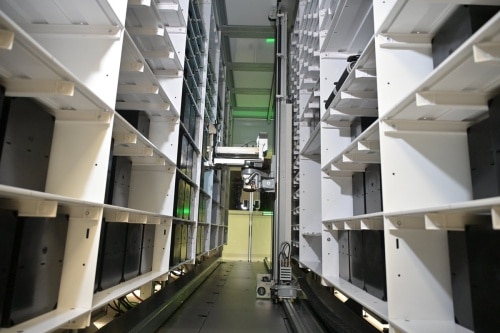
“From a medication safety point of view, the system can minimise human error in medication management. With the QR code verification, we can ensure the right drug will be given to the right patient at the right time,” said Helen Ho, pharmacy director at CUHK Medical Centre, pointing out that all the medication’s information can be accessed by scanning QR codes on the packages.
After a doctor prescribing the medication and a pharmacist verifying the prescription, a robot then takes over by taking from storage shelves the pre-packed medicine to be sent to the patient’s ward where it is rechecked by healthcare staff before administration.
The system packs the required dosage for each scheduled time individually to make sure patients take their medication on time and reduce the chances of missing and incorrect medication.
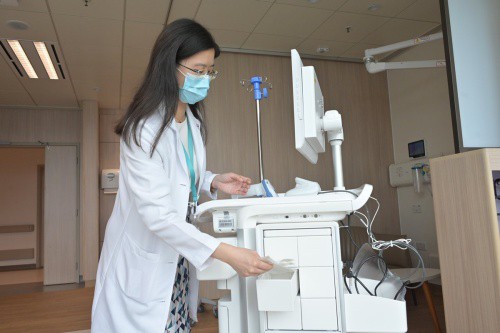
To further ensure that medication error in the hospital wards does not occur, the hospital has introduced an IoT-connected drug trolley called the E-Medcart into its medication distribution workflow. Healthcare staff need to scan the code on a patient’s wristband and verify the information to unlock the corresponding compartment on the trolley.
“If there is any unused medication, for example, because a patient’s condition has changed, the medication are returned to the pharmacy to be reused. This can reduce wastage,” said Ho.
Linen management system
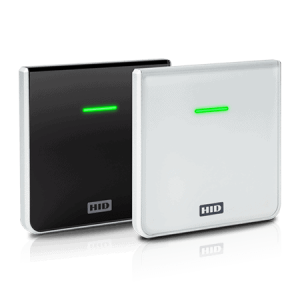
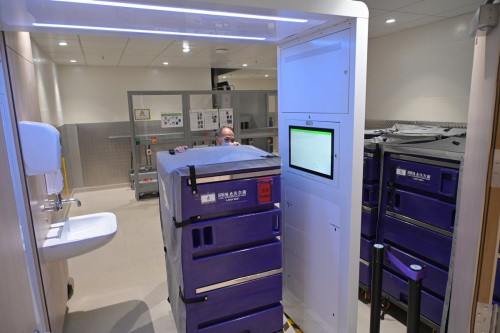
To track supplies of hospital linens, staff uniforms and patient garments, an RFID tag is attached to each piece. For one, hospital linen can be monitored closely with RFID, from the moment it is sent down chutes to laundry carts on the ground floor, to the moment it is sent to the contractor for washing.
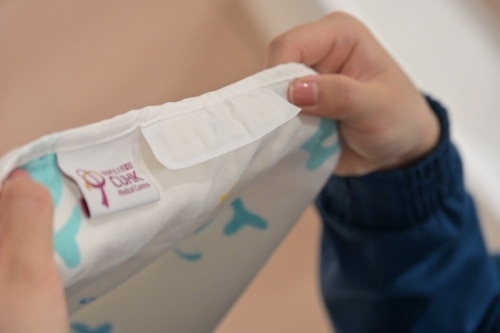
The RFID tags formed part of the newly installed linen management system, an IoT-based locker the distribute staff uniforms and patient garments. With the system, hospital staff can also place their used uniforms in the return machine and retrieve a fresh set in their size from the dispensing machine.
According to Jessie Lam, the medical centre’s chief hospital administrative officer, when new employees join the hospital on the first day, they are checked for uniform sizes.
“For each staff member, the maximum number of uniforms we will dispatch to them is two sets. If they do not return their uniform, we are unable to dispatch another uniform to them.”
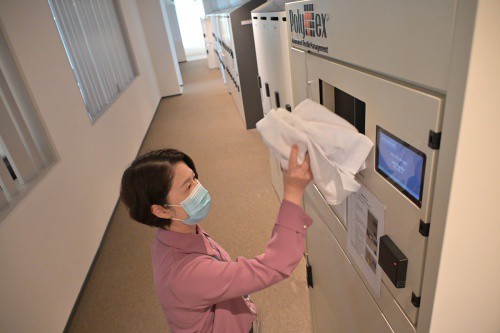
Putting the system in place saves the hospital from hiring extra manpower. In the traditional way of managing linen in hospitals, Lam said it would require extra manpower from 9am until 6pm, but the automated system enables the hospital to operate it on a 24-hour basis.
Meanwhile, other technologies currently being used in the hospital includes the paperless electronic medical record, mobile information and communication technology; and the strengthening the security in paediatric ward with geo-fencing technology.
After eight months of trial operations, the CUHK Medical Centre officially opened in September.
“We bridge the service gap between the public and private healthcare systems and to provide the local community with a new choice of quality and transparent healthcare services,” said Dr. Chien Lee, chairman of the board of directors at CUHK Medical Centre, during the opening ceremony.
He added: “As a non-profit private teaching hospital, we will also assume a major role in promoting medical innovation and training medical professionals. With a team united in its purpose and with solid support from the community, we will be able to achieve our mission of ‘Pioneering Solutions in Healthcare’.”