




The term artificial intelligence (AI) was coined by John McCarthy in 1956. A mathematician, he championed mathematical logic for AI, and referred to it as the “science and engineering of making intelligent machines.”
He later developed the Lisp programming which quickly became the programming language of choice for AI applications following its publication in 1960. McCarthy is considered as one of the “founding fathers” of AI alongside Alan Turing, Marvin Minsky, Allen Newell and Herbert A. Simon.
As with all things man-made, AI has evolved over the years as new technologies emerge.
The late Stephen Hawking predicted that AI would “take off on its own and redesign itself in an ever-increasing rate.” I am not sure whether his view is influenced by popular movies like Terminator franchise, Ex-Machina or 2001: A Space Odyssey.
Phil Bunkard, former CIO of BT and now strategy director for Republic of Things, saw an overlap between AI and the Internet of Things (IoT). In an opinion piece of techuk.org, he wrote: “There is a clear intersection between the Internet of Things (IoT) and Artificial Intelligence (AI). IoT is about connecting machines and making use of the data generated from those machines. AI is about simulating intelligent behaviour in machines of all kinds.”
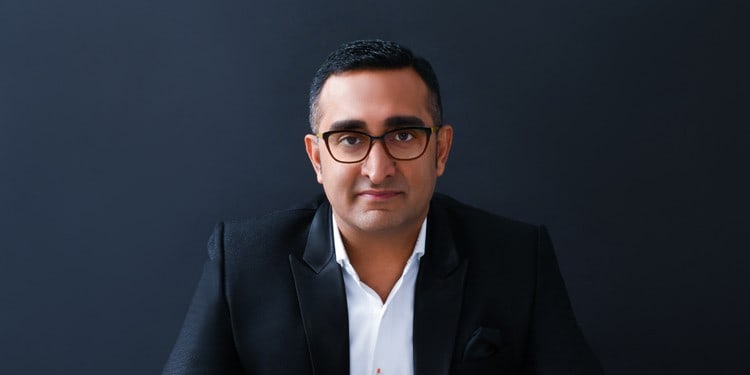
Asheesh Mehra, co-founder and group CEO of AntWorks, offered his definition of AI as follows: “When we looked at AI in the context of IoT, two big words stand out for me – data and machine learning. IoT generates a tremendous amount of data, and machine learning makes sense of those data.”
“Data on its own, whether structured or unstructured, means nothing to an individual if action is not taken. In my view, the conversion of how AI plays a role – creating buckets of unstructured data into structured data, which can be used for decision making and is key to every company,” he commented.
What follows is a further deep dive into IoT and its relationship to AI.
How are enterprises capitalising on the data being generated by IoT?
Asheesh Mehra: There is an evolution taking place in the world of IoT and AI world. And the example that you’ve used – the data has been used for the status of bags being delivered.
The data collected from scanners give you the possibility of the weight, size, colour, shape and brand of the bag. Today’s AI technology can capture and make sense of the data to perform lock mode analytics for various reasons.
When you look at creative analytics, it’s about predicting what will happen. For prescriptive analytics, it’s about what should be done. For adaptive and continuous analytics, it’s about appropriate actions to be taken with that data. So did the HK airport use that data with an IoT device? They absolutely did, for a very specific and niche purpose. But as we and technology evolve, we use that data for a much larger purpose than just bag arrivals.
What is stopping organisations, for example the Hong Kong Airport Authority (HKAA), from adopting AI to mine the data being generated by IoT?
Asheesh Mehra: In my view, there could be a few reasons why some organisations are taking baby or giant steps towards next-generation IoT or AI technologies. One fundamental reason could be the incremental cost factor. Their basic need is to make sure bags land in HK airport. Why would they look at enhancing the technology when they have not recovered from their initial investment? So, a cost driver could be one reason why organisations may not want to embrace the usage of new edge technologies right away.
The second reason could be the lack of need to understand or capture larger amount of data. This is why businesses need to better understand the purpose of the IoT device.
Lastly, it could be the understanding level of a particular enterprise of what the initial data could deliver for them.
With these 3 factors in mind, one can either embrace the next generation technology or wait to recover the initial investment before moving forward.
Where are we at when we look at the landscape of the usage of AI and advanced IoT? What are most enterprises doing with IoT?
Asheesh Mehra: When you’re looking at the enterprise landscape or industries, there’s banking, mortgage, logistics, transportation and education. Each vertical is at a different stage of evolution with the use of IoT. Financial services will always be the front runner when it comes to experimenting with new technology or evaluating a new way of doing business. For traditional industries such as the healthcare space, cutting edge technology is needed.
When we look at back-office operations, they are still using green screens from an administrative perspective. Each industry has a different journey of using IoT devices.
If you ask me across Southeast Asia or Asia-Pacific regions, I would rate the adoption level in some industries a lot higher than others, because it comes down to use cases that have been proven, or budgets, size of the population, investments and how quickly the returns from investments come in.
Among businesses that you’ve met, what is the level of receptivity towards the use of AI in IoT?
Asheesh Mehra: You have the do-ers and the evangelists, and I’d say 30-40% listen to you very attentively and are keen to progress towards a proof of concept and would want to go out and do something about it, because these are the people who are believers and leaders; people who like to set the trend and will do something about it.
Then there is the next 30-40% that want to do something and get educated, making you spend a large amount of time in doing a demonstration and educating them, but they will not end up taking action.
Lastly, there is the 15-20% laggards who are either too scared or non-believers. They are very closed off in whichever way you try to educate or show them demonstrations. You can get them to talk to existing customers who are using the technology, but they remain sceptics.
So you have the do-ers, the evangelists, and the absolute naysayers who don’t believe in it and just won’t do anything at all.
What are the factors limiting more rapid adoption in AI in the market today?
Asheesh Mehra: It is really about the organisation having the bandwidth within their teams to create centres of excellence and delegating teams to this initiative because everybody has a day job to run while chasing top and bottom lines. Everybody has a shareholder and market to respond to. So, one reason would be enterprise bandwidth to dedicate to an AI or automation program.
The second limitation will be the sharing of data, especially for financial services and healthcare organisations. There’s confidential data and most countries have restrictions on personal data being shared outside of their organisations, but the engine needs to learn and understand patterns from these data. So, the availability of sample sets with the required information is another limiting factor for the acceleration of AI adoption.
The third limitation is the willingness to invest in new technologies. If you go to IBM, a small initiative will cost you $3 to $5 million, but there are so many new organisations like AntWorks around the world that have simplified AI and made AI more affordable. But again, budgets do impede because when most organisation put a dollar out, the CFO would want a clear return on the investment.
In my view, it’s a matter of the next two to three quarters that you will see a serious acceleration in the whole AI world.