FutureCOO

Tag: construction industry

  • Singapore construction investing 28% of expenditure into technology

    Singapore construction investing 28% of expenditure into technology

    Autodesk’s “State of Digital Adoption in the Construction Industry” reveal that Singapore’s construction sector is increasingly investing in technology.

    In 2025, firms allocated 28% of their expenditure to new technological solutions, a significant rise from 21% the previous year. This trend underscores the sector’s commitment to digitalisation amid growing pressures for efficiency and safety.

    The report highlights that construction firms in Asia Pacific (APAC) are now using an average of 6.2 technologies, marking a 20% increase from 2024. In Singapore, the average is even higher at 7.3 technologies, indicating a robust appetite for innovation.

    Notably, the proportion of businesses recognising technology as integral to their growth strategy has grown steadily, with 47% now identifying new technology as a key driver for project work.

    Digital maturity correlates directly with improved project outcomes. Companies that embrace advanced technologies report delivering 1.5% more projects under budget and 1.1% more on time.

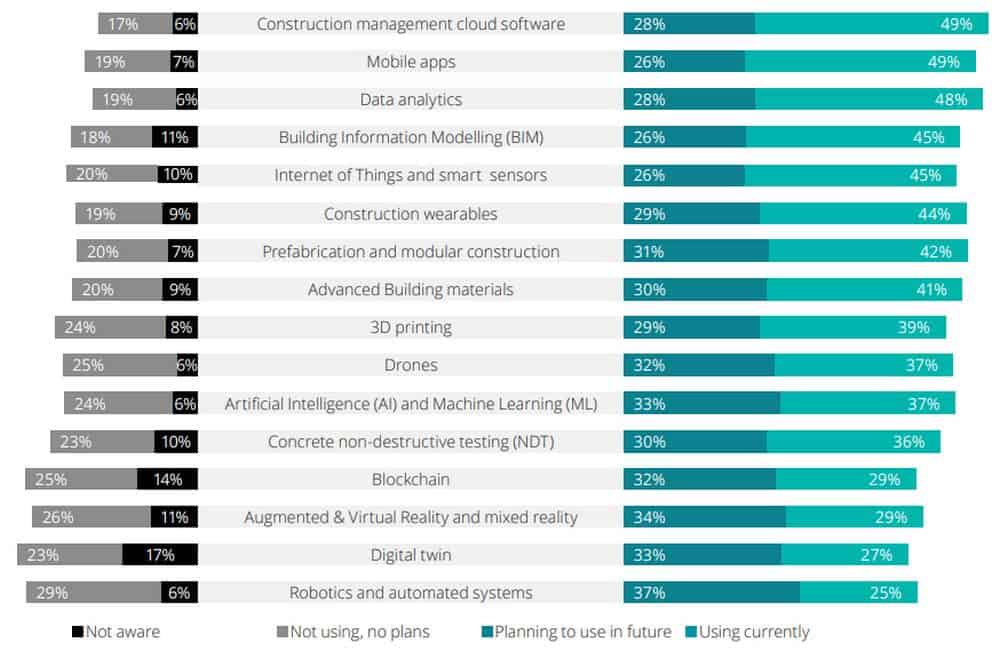
    Current and planned use of technologies
    Source: Deloitte Access Economics based on construction and engineering business survey (2025).
    Sample: 894

    For a typical business with S$100 million in revenue, this translates to an estimated S$1.14 million in additional revenue growth and a 50% reduction in safety incidents.

    Despite the apparent advantages, the construction industry remains fraught with challenges, particularly concerning safety. The Ministry of Manpower in Singapore reported over 800 safety violations at more than 300 construction sites during recent inspections.

    The sector accounted for 20 out of 36 workplace fatalities, highlighting the urgent need for enhanced safety measures. The report suggests that firms with higher digital maturity experience fewer safety incidents; 41% of businesses employing multiple technologies noted a decrease in such incidents.

    Government initiatives, including the Building and Construction Authority’s (BCA) Industry Transformation Map, play a crucial role in fostering this digital shift. These initiatives mandate the adoption of digital tools such as Building Information Modelling (BIM) and Integrated Digital Delivery (IDD), aimed at optimising costs and improving site safety.

    However, barriers to further adoption persist. A significant 35% of firms cite uncertainty about the necessary technical skills as a major obstacle.

    Nevertheless, the landscape is improving, with only 25% of businesses reporting skills gaps as a barrier in 2025, down from 55% in 2023. Proactive upskilling initiatives are underway, supported by government grants aimed at reducing the financial burden of technology adoption.

    As Singapore’s construction sector continues to embrace digital transformation, the focus on effective change management will be essential in unlocking the full potential of these investments.

    By strategically aligning technology adoption with clear business objectives, construction firms can navigate the complexities of the industry while enhancing safety, efficiency, and overall performance.

  • Asia’s construction industry: Embracing innovation amid evolving challenges

    Asia’s construction industry: Embracing innovation amid evolving challenges

    As the construction and civil engineering sector in China and Hong Kong undergoes rapid digitalisation, industry leaders are harnessing advanced technologies to enhance efficiency and collaboration. This transformation is crucial for addressing pressing challenges such as labour shortages and sustainability.

    Current landscape of the construction industry

    In mainland China, the construction industry has witnessed remarkable growth over the past three decades. However, as Sankar S. Villupuram, director and East Asia Digital Services Leader at Arup, recalls, “During the pandemic, countries increased infrastructure investments; however, most of the major markets have not yet recovered after COVID.”

    This situation has resulted in a surplus of residential properties, yet fewer investors, leading to a significant shift within the industry. The repercussions of these changes are felt across various stakeholders, including consultants, contractors, and civil engineers.

    In Hong Kong, recent reports indicate that while there was a surge in construction activity during the pandemic, many sectors are still grappling with its aftershocks. The Hong Kong Construction Industry Council has underscored the ongoing need for infrastructure investment, emphasising that recovery remains challenging for many firms.

    The digital shift in construction

    Historically, the construction industry in Asia has been slow to adopt new technologies. However, recent trends indicate a significant shift towards digital solutions. According to a report by McKinsey & Company, the construction sector in Asia is projected to grow by 6% annually over the next five years, largely driven by digital innovation.

    Villupuram emphasises that “the integration of digital tools is not just about keeping up with global trends; it’s about survival in an increasingly competitive market.”

    Data standardisation and productivity

    As the industry adapts to these changes, effective data management becomes paramount.

    “Mature organisations leverage data analytics to discover answers through a process-driven approach, while emerging companies often seek answers before conducting analytics.” Sankar S. Villupuram

    This highlights a critical challenge: the need to make sense of the vast amounts of data available.

    A successful data standardisation process involves transforming raw data into actionable insights. Villupuram cites the example of Hong Kong Airport, which aspires to become a data-driven entity.

    “The key is transforming data into actionable insights through comprehensive analysis,” he emphasises. This focus on data-driven decision-making is essential for organisations aiming to enhance productivity and collaboration across departments.

    Addressing labour shortages

    One of the most pressing challenges facing the construction industry is a shortage of skilled labour. Villupuram points out that the traditional workforce model is no longer sustainable. As populations age and younger generations seek different career paths, the industry must adapt. Digitalisation offers a solution by automating repetitive tasks and enhancing productivity.

    Villupuram highlights the shift in education towards interdisciplinary programmes that combine practical skills with technical knowledge. “Skill development is crucial,” he states, pointing to initiatives like the Vocational Training Council (VTC) in Hong Kong, which prepares individuals for industry demands.

    For instance, Building Information Modelling (BIM) has become a cornerstone of modern construction practices, allowing for better project visualisation, improved collaboration among stakeholders, and more efficient resource management. Villupuram noted, “BIM not only streamlines processes but also reduces errors and rework, which are costly in both time and resources.”

    Sustainability through technology

    Sustainability is another critical concern for the construction sector. The increasing urgency to address climate change has prompted many companies to rethink their approaches to building design and construction methods.

    Sankar S. Villupuram

    “Sustainable practices are no longer optional; they are essential for the future of our cities.” Sankar S. Villupuram

    Innovations such as modular construction and 3D printing are gaining traction, as they reduce waste and lower carbon footprints. Additionally, data analytics plays a vital role in optimising energy use throughout a building’s lifecycle. By leveraging these technologies, companies can create structures that are not only environmentally friendly but also economically viable.

    The role of collaboration

    Collaboration is key to successful project delivery in the construction industry. Villupuram emphasises the importance of breaking down silos between different stakeholders—architects, engineers, contractors, and clients. “Digital platforms facilitate real-time communication and collaboration,” he explains. This interconnectedness leads to better decision-making and more cohesive project outcomes.

    Arup has been at the forefront of developing collaborative tools that integrate various aspects of project management. These tools enable teams to share information seamlessly, track progress, and address issues promptly. Villupuram remarks that when everyone is on the same page, projects run more smoothly, leading to increased client satisfaction.

    Innovations driving change

    Several recent innovations are making waves in the Asian construction landscape:

    • Artificial Intelligence (AI): AI is transforming how projects are planned and executed. From predictive analytics that forecast project risks to AI-driven design tools that optimise building layouts, the potential applications are vast. Villupuram opines, “AI can analyse vast amounts of data quickly, providing insights that humans might overlook.”
    • Drones and Robotics: Drones are being employed for site surveys and inspections, significantly reducing the time required for these tasks while enhancing safety. Robotics is also making its mark, with automated machinery taking on dangerous or monotonous tasks on-site. Villupuram believes these technologies not only improve efficiency but also protect workers from hazardous conditions.
    • Virtual Reality (VR) and Augmented Reality (AR): VR and AR technologies are revolutionising how stakeholders interact with projects before they break ground. These immersive tools allow clients to experience designs in a virtual space, providing valuable feedback early in the process. “This level of engagement helps align expectations and reduces costly changes later on,” Villupuram explains.

    The future of construction

    Looking ahead, digital transformation will continue to shape the construction landscape in Asia. Optimistic about the future, Villupuram remarks, “The potential for innovation is limitless. As we embrace new technologies, we will not only enhance our efficiency but also create more sustainable and resilient built environments.”

    The construction industry must remain agile and open to change if it hopes to thrive amid evolving challenges. By harnessing advanced technologies and fostering collaboration among stakeholders, companies can position themselves at the forefront of this transformation.

    For Villupuram, digitalisation is not just a trend; it’s a fundamental shift that will define the future of the construction industry. As the industry navigates this new landscape, embracing innovation and adaptability will be essential for achieving long-term success and addressing the pressing challenges of the future.

  • Terabee unveils IoT device for efficient materials monitoring

    Terabee unveils IoT device for efficient materials monitoring

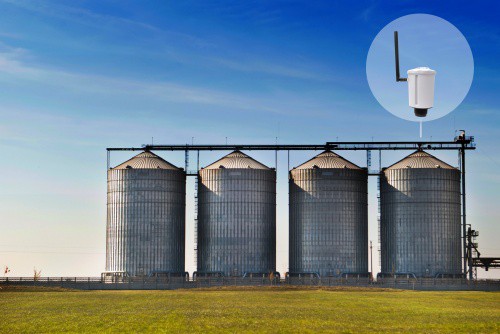
    Terabee, provider of sensor solution, has launched a LoRaWan-based device for monitoring fill level of remaining materials inside  tall silos, vats and tanks aimed at organisations engaged in smart agriculture, construction and waste management.

    With monitoring level up of up to 60m detection range, the low-energy,  battery-powered  sensor is designed to optimise stock replenishment, cut operational costs and reduce dangerous silo audits at great heights.

    The new Terabee LoRa Level Monitoring XL device can be conveniently installed on top of silos and tanks, providing over-the-air data about real-time fill levels of stocked materials, whether they are liquids, solids or powders.

    “Wireless communication and battery-power are features that our customers have frequently requested  in the past year. We’re glad to be responding to customer and market demand by launching this product. This will now allow our clients to reduce cost, time and complexity during device installation on top of silos. It will also enable easier deployment in remote locations,” said  Max Ruffo, CEO and founder, Terabee.

    IoT enables more efficient stock monitoring

    Until recent years, monitoring stock and materials levels has been dominated by both contact-based and non-contact transmitters.  The growth of IoT has seen an increase in contactless level sensors, capable of providing years of autonomy through their battery powered design, while achieving cost-effectiveness. Moreover, kilometres of data transmission coverage is gained through LoRaWAN technology.

    Terabee plans to work with IoT solution providers and integrators, who are looking for third party, ready-to-install devices that will feed existing applications with useful data about material stock in silos and tanks.

    “We’ve also received interest from a wider range of sectors and organizations than expected — people who are looking for effective ways to digitize material levels in places and in assets not previously digitised. This includes telecommunications companies providing LoRaWAN network infrastructure, silo and farming equipment manufacturers, material transportation and storage companies, to name some,” said Ruffo.

    A range of benefits

    According to Ruffo, Terabee’s new level monitoring device has positive impact across operations, budget, staffing deployment and planning.

    Some of the key benefits include:

    • Time and cost savings – Installing Terabee IoT sensors on top of silos, eliminates or minimises time spent by staff to manually inspect remaining content levels in silos and tanks. This results in lower operational costs and enables staff to focus on other critical business functions.
    • Improved staff safety -With the use of Terabee LoRa Level Monitoring XL sensors regularly measuring and sending (over the air) data about real-time material level in customer silos, there is no need to have people climb and visually audit remaining contents. This often can be a dangerous task and requires specific equipment.
    • Ensure optimal use of equipment – In some cases, silos are emptied and not re-filled nor used for weeks or months. This mostly happens because silo owners do not know that the silos are empty. Knowing the current fill level of silos will minimize equipment downtime and ensure more efficient use.
    • Optimise stock replenishment process – With everyday data being gathered from each silo, the overall material restocking process can be better planned and optimized, saving costs and time in the process. This can be done by looking at historic refilling cycles at different periods.

    For farmers, this enables leaner material restocking. Material providers, such as animal feed producers or suppliers, will have far more accurate estimations of upcoming production quantities and route optimization for deliveries. As a roll on effect, CO2 emission will be cut too.

    • Eliminate unreliable approximations – From client discussions Terabee heard a number of old school methods to approximate remaining content quantity in silos or tanks. One that stood out was “banging on the bottom part of the silo and listening for acoustic feedback”. Material in different quantities would produce a different sound and give the user a rough idea on the remaining contents.

    Such methods, unfortunately may result in errors in material quantities which may lead to:(a) running out of stock too fast, which can put farm animals at risk or block production lines; (b) delivering stock too soon and having no space to receive and stock the new delivery before the current stock is consumed. The user either needs to find new, unsecure ways to stock the material or pay extra for a return delivery at a later date.

    Modern industry cannot rely on quaint, outdated methods – like banging the bottom of a tank – and remain competitive. Digital stock level monitoring is the new way to get smart and gain efficiency.

    Founded in 2012 in France, Terabee digitises movement to enable digital transformation. Mastering multiple sensing technologies, the company provides sensor modules and sensor-based solutions for Industry 4.0, smart buildings, smart agriculture, mobile robotics – and during this global pandemic, Covid-19 relief.

  • Wika deploys BIM to speed up Jakarta hospital construction

    Wika deploys BIM to speed up Jakarta hospital construction

    Construction firm PT Wijaya Karya (Persero) Tbk (Wika) has turned to digital solutions, integrating its modular approach to construction with BIM technology to build one of the 14 new hospitals commissioned by the Indonesian government to address the shortage of bed capacity because of rising COVID-19 cases.

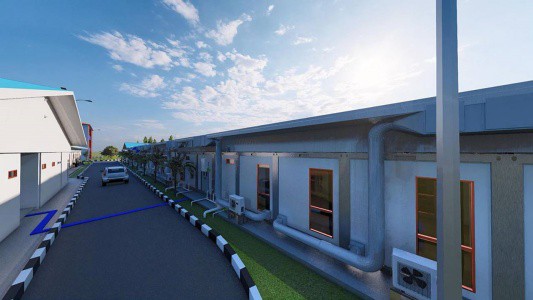
    The hospital, costing approximately US$4 million, is a one-storey building with a capacity of 300 beds, 35 intensive care unit rooms, and 10 emergency rooms. It occupies a 22,700sqm former football field in South Jakarta.

    It is a modern facility equipped with a negative pressure isolation system to prevent the flow of virus-contaminated air, eliminating the spread of infectious pathogens to the surrounding environment, and includes a robotic nurse and an integrated command centre to connect it to 65 other hospitals.

    In an article published trade publication Southeast Asia Construction, Wika shared how innovative solutions using drone and BIM technology help in building the hospital on time and within budget amidst the challenging COVID-19 situation.

    Construction under time pressure

    The Indonesia government instructed Wika to complete design and construction works, as well as have the hospital fully operating, in less than a month. Delivery also needed to be cost-effective and environmentally sustainable.

    To meet these project requirements on a very tight timeline is no easy task with current social distancing measures. The company needed digital solutions that could fast-track construction by coordinating and accelerating engineering workflows, while at the same time addressing the various planning, collaboration and management challenges of the project.

    By using BIM technology to digitally collaborate, Wika was able to rapidly progress through the design review process, manage complexity of design changes during construction, and achieve efficiency in time, cost, and quality.

    “BIM facilitates the creation of designs that are complex to the construction process, starting from initial digital design to manufacturing workflows in all lines of construction disciplines,” Romi Ramadhan, BIM manager at Wika told trade publication Southeast Asia Construction.

    BIM stands for Building Information Modelling, the process of generating and managing building data during its design, construction and during the building or assets life cycle. Typically, the process uses three-dimensional building modelling software to increase productivity of consultants and contractors during the whole asset life cycle.

    The process produces the Building Information Model database, which encompasses building geometry, spatial relationships, geographic information, quantities and properties of building elements. It is a new way of working using new technology to facilitate project management, better construction process control, cross-disciplinary collaboration, communication with external stakeholders, decision support and risk management.

    Establishing a connected data environment

    To implement its BIM strategy, Wika needed interoperable modelling applications and a unified digital platform. To do this,  the company established a connected data environment using ProjectWise, and adopted Bentley’s reality modelling and BIM methodology to carry out its modular approach.

    Wika used a quadcopter drone and ContextCapture to capture and process images of the 2-ha project site, creating a reality model of the topographic area. With OpenBuildings Designer, Wika generated a model of the entire hospital building, including structural, architectural, and MEP elements, as well as incorporated landscape and roadway design with OpenRoads.

    To optimise design of the indoor airflow system to support patient recovery and prevent viral transmission, Wika used Hevacomp to perform airflow analysis and simulation within the building model, designing an HVAC system that complies with proper standards. The company integrated the 3D models with the construction schedule and costs using Synchro 4D while using LumenRT for visual animation, improving construction visualisation for better design verification.

    Leveraging Bentley’s interoperable applications, Wika implemented a collaborative BIM methodology, enabling immediate access to real-time data and 3D models without needing to be in the same room. The integrated digital modelling solution facilitated survey, design, simulation, and visualisation, allowing design and construction to occur simultaneously, identifying and resolving design clashes, and making virtual changes to avoid errors and costly rework on site.

    ProjectWise and Navigator especially helped coordinate the various, geographically dispersed engineering disciplines resulting in faster decisions throughout the project lifecycle. “The end result is that Bentley Systems can cover the end-to-end processes both in terms of engineering and management,” said Ramadhan.

    Working in a connected data environment, 13 multidiscipline BIM engineers collaborated from home, streamlining workflows and increasing productivity to keep the tight project schedule on track.

    The connective data environment also improved visualisation and decision-making without everyone needing to be in the same room, important during the global pandemic. Bentley’s BIM technology played a vital role in modular design and construction, which can slowly shift the world of construction from conventional to digital and industrialise construction project delivery.

    Getting the job done

    Wika completed 95 design revisions and resolved 62 clashes in three days to deliver the modular design in only 10 days, saving US$400,000. The company used synchro 4D to perform construction simulation and manage the construction process, which reduced construction time by four days to complete construction within 16 days, 20% faster than targeted.

    Working in a unified BIM platform provided complete insight into planning, costs, scheduling, and construction, improving cost efficiency by 18% while optimising quality. Integrating its modular approach with Bentley’s BIM technology, Wika increased its return on investment by 24% and accelerated hospital operations by two months. The ability to extract accurate material quantities from the 3D models – combined with the sustainability of the modular construction process – contributed to saving up to 3,000 cu m of material waste and 10% of project costs.

    “Bentley technology has the capabilities and tools to make effective and efficient modular workflows, so we can optimise project costs and improve efficiency of the design process,” said Rizky Yusuf Ramadhan, BIM coordinator at Wika. “We continue to build more and more modular hospitals using Bentley technology as quickly as possible to save more lives.”

    Moving forward, Wika plans to expand BIM application and develop a digital twin for lifecycle management of the modular facility, serving as a benchmark for future developments within the industry.
Subscribe