In 2026, data centre chief operating officers (COOs) in Southeast Asia face ongoing challenges in managing AI-driven growth while addressing sustainability and regulatory compliance.
The Uptime Institute Global Data Center Survey 2025 highlights an industry contending with rising costs, power constraints, and demands from AI, where sustainability metrics collection has stagnated due to increasing power needs and varying regulatory pressures in some regions.
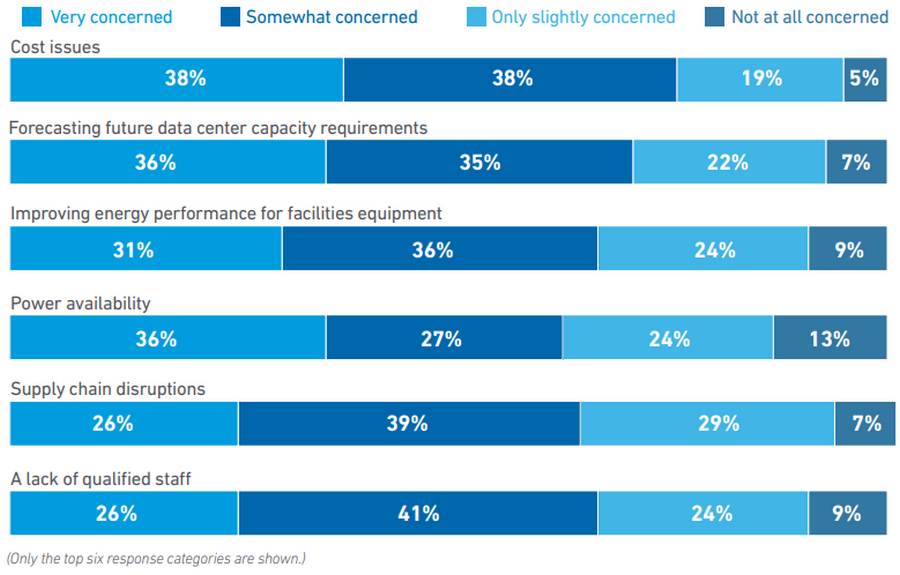
Looking at the next 12 months, how concerned is your digital infrastructure management
regarding each of the following issues? (n=638)
Source: UpTime Institute 2025
As AI workloads increase, regional capacity is forecast to double from 13 gigawatts in early 2025, adding to electricity demands. Despite these issues, the survey notes gradual improvements in outage frequency and continued adoption of hybrid IT strategies.
Yet, amid strained grids and public scrutiny, innovative COOs can pivot to prosperity by blending tech advances with strategic alliances.
Southeast Asia DCs 2025?
Southeast Asia’s data centre landscape in 2025 buzzes with expansion, fuelled by digital transformation, 5G, IoT, and especially AI. Daniel Pointon, Group CTO at STT GDC highlights AI as the “primary catalyst,” with operational capacity across the Asia-Pacific region reaching 13 gigawatts, set to double in three to four years.
Research supports this: the region’s market is projected to grow at a 19.4% CAGR through 2026, with Indonesia, Malaysia, and Singapore leading the way.
Supportive policies, like Indonesia’s renewable incentives, enable this boom, but constraints in Singapore and Johor, Malaysia, signal grid pressures. Pointon points to the role of governments in facilitating infrastructure for AI benefits.
By mid-2025, emerging hubs like Thailand and Vietnam are shining, offering vast utilities and approvals, in contrast to North America’s gigawatt campuses. For COOs, this involves identifying suitable sites in a market projected to reach US$30 billion market by 2030.
STT GDC overview
ST Telemedia Global Data Centres (STT GDC) is a global colocation provider, operating in 12 countries with over 100 facilities and two gigawatts of capacity. Pointon describes it as an end-to-end operator managing physical infrastructure, including power, cooling, and security.
In 2025, amid Asia’s focus on sustainability, STT GDC maintains targets aligned with regional decarbonisation efforts. Pointon notes the company’s early actions in this area, which help clients address compliance while expanding.
Research shows that such operators win by integrating renewables and aligning with ASEAN’s decarbonisation goals.
AI’s energy influence
AI workloads affect energy use by increasing demand and encouraging efficiencies. Pointon outlines two impacts: higher megawatt requirements from GPU computing, which strain grids like Johor’s, partially offset by technologies such as liquid cooling.
Net consumption rises, with 2025 projections indicating data centres could double global electricity use to 536 TWh. In Asia, inference workloads prevail, less demanding than North America’s training sites, but still substantial.
Research suggests ASEAN emissions may increase without faster renewable adoption, with data centres potentially matching the power use of millions of homes by 2030.
Pointon highlights efforts in Indonesia and Thailand to develop infrastructure, advising COOs to prepare for larger-scale demands. Infrastructure upgrades, including medium-voltage distribution and solid-state transformers, may help reduce losses.
National sustainability alignment
Data centre operators are aligning with national initiatives, though progress varies. Pointon discusses STT GDC’s focus on scope 2 emissions through renewables, noting limited green supply in Asia-Pacific despite potential.
Yet, the Asia-Pacific lacks sufficient green supply despite its potential. Regulations are tightening: Singapore, Japan, and South Korea are mandating low PUE for permits, mirroring China’s longstanding rules.
Pointon recommends collaboration with utilities for grid planning, as data centres impact national consumption.
Research indicates ASEAN aims for 10% annual renewable increases in data centres through 2025, combining efficiency and green energy. Some regulators see AI as contributing to productivity and emissions reductions in other sectors.
For COOs, this means joint infrastructure planning over 5-10 years to support renewables and navigate diverse markets.
Tech for sustainability
Affordable tech innovations promise sustainability without breaking the bank. Pointon highlights GPU computing for AI, achieving 10-20x efficiency gains over CPUs, as measured in tokens per kWh. Generations evolve rapidly, amplifying this.
Liquid cooling follows, reducing PUE from 1.5 to 1.6 to under 1.2, and even to 1.1, by targeting heat sources directly. “We’ve got a number of liquid-cooled installations across our portfolio. Every new data centre is liquid-cooled ready,” shared the group CTO.
“We’ve got dozens of liquid cooled customers across the group and we see that as a really tangible step forward in terms of the sustainability of the sector.” Daniel Pointon
2025 trends align: advanced cooling systems dominate, driven by AI’s heat, while green data centres in APAC grow at 14% CAGR to US$295 billion by 2035.
Regulations in Singapore and beyond incentivise these, with AI optimising cooling via machine learning. COOs can deploy these solutions affordably, as costs decrease with scale, ensuring both compliance and competitiveness.
Integrating goals efficiently
For 2026, Pointon advises COOs to select providers that balance technology and sustainability. Whether buying hardware, leasing space, or utilising the cloud, evaluate sustainability ambitions alongside performance.
“I think it’s about picking a technology provider be it whether you’re buying computer equipment or whether you’re leasing collocation space or whether you’re subscribing to a cloud service,” said Pointon. “I think it’s about choosing a product or a service that’s not just fulfilling your technology needs but also fulfilling your sustainability needs as well.”
STT GDC exemplifies this, offering technologically excellent, eco-friendly services. Research supports the fact that successful operators in Southeast Asia integrate renewables and efficiency to meet growth targets amid rising energy costs.
With AI demand exploding, this dual lens prevents costly retrofits, aligning with stakeholder expectations in a regulated era.
Stakeholder best practices
Sustainability demands stakeholder buy-in – this process alone of getting stakeholder buy-in is in itself a challenge for most leaders.
Pointon recommends mapping material topics—such as energy for tech firms—then proposing solutions, not just problems.

“I think it begins with being able to firstly narrow in onto which of the topics that are really material for the business, not necessarily try and boil the ocean and solve everything from the outset.” Daniel Pointon
Benchmark against peers and heed investors like Temasek, which demands rigorous standards. This calibrates ambitions. In 2025, urban digitisation studies stress collaborative transitions, with ASEAN urging joint decarbonisation.
Pointon’s experience at STT GDC demonstrates that communicating via materiality, peer insights, and stakeholder alignment motivates action, fostering commitments to the environment and community.
As 2026 approaches, COOs applying these strategies—based on Pointon’s insights and 2025 trends—can manage challenges. Through renewables, efficient technologies, and collaboration, they can support Asia’s digital economy while addressing sustainability.
Click on the PodChats player and listen to Pointon elaborate on how to Achieve Data Centre Sustainability and Regulatory Alignment in 2026 from the perspective of the COO.
- To start, could you provide a brief overview of STT GDC’s business?
- In 2025, could you provide a brief overview of the state of DC operations in Southeast Asia? (13 Gigawatts)
- How will AI workload growth influence energy consumption and infrastructure needs?
- How are data centre operations taking national sustainability initiatives?
- How do you see Asia’s regional regulations on carbon emissions impacting data centre operations?
- What new technologies can improve both sustainability and compliance affordably?
- For 2026, any advice on how COOs can integrate sustainability goals with business growth targets effectively?
- Identify three best practices for engaging stakeholders to secure public and regulatory support?