
FutureCOO

Tag: submarine cables

  • New submarine cable innovations for the APAC region

    New submarine cable innovations for the APAC region

    In 2025, the Asia Pacific region—home to over 58% of the world’s internet users—is witnessing a transformative leap in submarine cable infrastructure.

    Opportunities abound in Japan’s emergence as a digital hub, and in the broader push for resilient, diversified networks that can withstand natural disasters and cyber threats. As demand intensifies, the region is poised to become a global leader in next-generation connectivity—if it can navigate the complex interplay of technology, politics, and security.
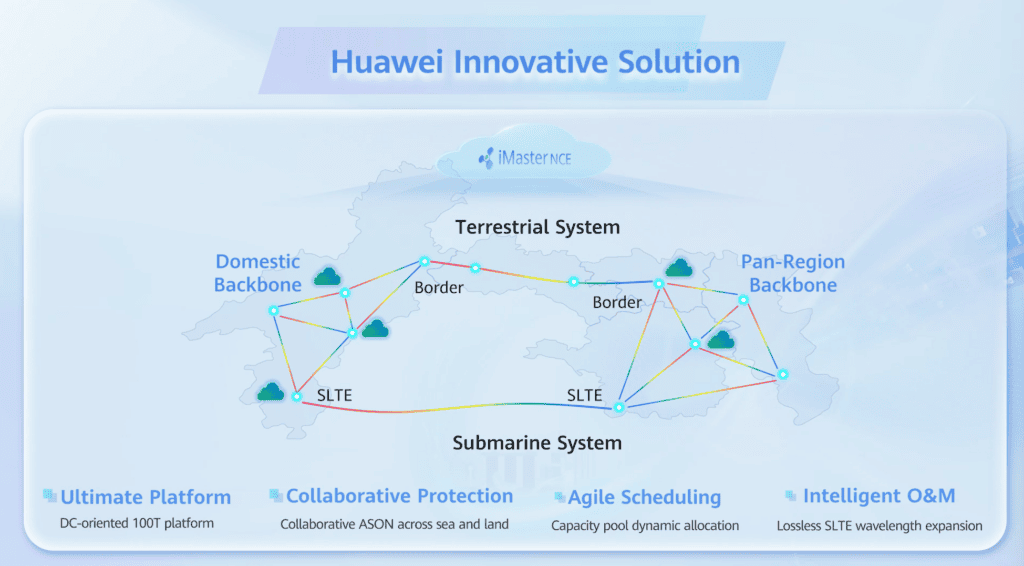
    Source: Huawei 2025

    In September, Huawei unveiled its ambitious vision for Submarine-Terrestrial Synergy and Optical-Intelligent Orchestration. This strategic approach aims to break down traditional barriers between submarine and terrestrial networks, facilitating a more integrated and efficient communication infrastructure.

    Huawei’s new flagship product, the OptiX OSN 9800 K series, represents a significant leap in submarine-terrestrial integration. This platform is designed to handle massive cross-domain data transmissions and boasts an impressive service processing capability of up to 100 terabits per second (Tbps).

    With features such as ultra-large capacity, high energy efficiency, and advanced intelligence for operations and maintenance (O&M), this solution is poised to transform the way data is transmitted across networks.

    “Our aim is to build an integrated submarine-terrestrial network architecture that is ultra-broadband, highly reliable, and intelligent,” said Gavin Gu, President of Huawei‘s Optical Transmission Domain.

    “By enabling seamless transmission and significantly enhancing network O&M efficiency, we hope to set a new standard in the industry.” Gavin Gu

    The platform’s energy efficiency is particularly noteworthy, with a power consumption of just 0.1 W/Gbit, which is 65% lower than the industry average.

    The global submarine cable system market, valued at $4,701.6 million in 2025, is projected to experience steady growth, driven by escalating demand for high-bandwidth internet connectivity and the expansion of undersea data centres.

    The increasing reliance on cloud computing and the proliferation of data-intensive applications, such as streaming services and the Internet of Things (IoT), are fuelling this demand. Furthermore, investments in 5G infrastructure and the ongoing development of subsea cable networks to support this technology are key growth catalysts.

    Meta’s commitment to robust digital infrastructure is evident in its ongoing projects, including the Bifrost and Echo subsea cables, which are designed to increase transpacific capacity by 70%. The Bifrost cable connects Singapore, Indonesia, the Philippines, and the United States, while the Echo cable provides 260 Tbps of capacity between Guam and California.

    As both Huawei and Meta continue to invest in the Asia-Pacific’s digital infrastructure, their efforts underscore the importance of collaboration between technology providers and telecommunications companies.

    The market is witnessing a shift towards higher-capacity systems, including those employing advanced technologies like coherent optical transmission and advanced fibre designs. This trend necessitates significant investments in research and development, ultimately benefiting leading players in the market.

    However, challenges remain, including high initial investment costs, the susceptibility of cables to natural disasters and geopolitical instability, and the complex regulatory landscape in various regions. Maintaining long-term operational efficiency and ensuring the security of these crucial infrastructure systems are continuous priorities for market participants.

    As Huawei and Meta advance their submarine cable projects, they are not only enhancing the region’s connectivity but also contributing to a robust digital economy that supports emerging markets. Together, these initiatives promise to empower businesses and individuals alike with faster, more reliable access to information and digital services, paving the way for future innovations.

  • New submarine cable

    New submarine cable

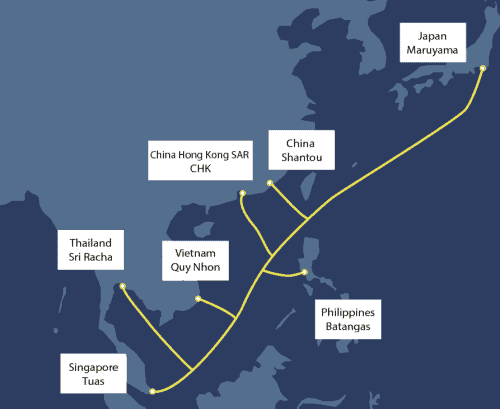
    Tata Communications (TC) has announced the integration of a new submarine cable system, TGN-IA2, into its network fabric. This development, constructed by the Asia Direct Cable (ADC) consortium, aims to significantly improve network connectivity for businesses operating in Asia and beyond.

    TGN-IA2 is designed to provide seamless connectivity, scalable bandwidth solutions, and high-capacity data transfer across multiple routes. This will enable enterprises, hyperscalers, and service providers to access diverse and resilient connectivity solutions from a single provider within their Intra-Asia networks.

    The new cable system will integrate with Tata Communications’ existing infrastructure, facilitating connectivity from Asia to key regions, including the US, Europe, the Middle East and Africa (EMEA), and India.

    Unlike traditional consortium-built systems, TC will have direct ownership and control over capacity upgrades on TGN-IA2. This independence will provide unmatched flexibility and scalability, allowing for faster provisioning and improved business readiness for customers.

    “At Tata Communications, we remain steadfast in our commitment to investing in cutting-edge subsea cable systems to meet our customers’ growing demands for scalable, diverse, and high-performance connectivity solutions,” said Genius Wong, executive vice president – core and next-gen connectivity services and chief technology officer, Tata Communications.

    “Whether you’re a cloud provider expanding into Asia, an MNC seeking low-latency connectivity across continents, or a digital business scaling globally, TGN-IA2 is a foundation for your future. This latest enhancement to our network fabric will further strengthen Tata Communications’ position as a global leader in smart, secure, and scalable connectivity and cross-border innovation.” Genius Wong

    Customers in sectors such as financial services, e-commerce, and logistics, which rely on fast and secure data transit between Asia and major global hubs, can expect several benefits.

    These include improved latency for faster internet speeds and streaming quality, enhanced reliability and redundancy to ensure business continuity, and greater network diversity through interconnection with the existing submarine cable system TGN-IA (Tata Global Network Intra-Asia). This infrastructure is also designed to support future digital services and applications.

    The addition of TGN-IA2 aims to empower businesses to compete and grow in the evolving digital economy by providing a network that adapts to changing needs and supports data-intensive applications such as AI, data centre-to-data centre connectivity, and high-definition streaming.

  • ADC Consortium to boost APAC IoT connections with new submarine cable

    ADC Consortium to boost APAC IoT connections with new submarine cable

    The Asia Direct Cable (ADC) Consortium is building a new submarine cable that among other things will boost IoT connections across Asia Pacific.

    The ADC is a global consortium comprised of leading communications and technology companies, including China Telecom, China Unicom, CAT, PLDT Inc., Singtel, SoftBank Corp., Tata Communications and Viettel.

    ADC Consortium founding member China Telecom Global (CTG) said the high-performance submarine cable will China Mainland and Hong Kong SAR), Japan, the Philippines, Singapore, Thailand and Vietnam.

    Expected to be completed by the fourth quarter of 2022, the 9,400km-long ADC cable will feature multiple pairs of high capacity optical fibres and is designed to carry more than 140Tbps of traffic, enabling high capacity transmission of data across the East and Southeast Asian regions.

    ADC’s high capacity allows it to support increasingly bandwidth-intensive applications which are being driven by technological advancements in 5G, the cloud, the internet-of-things and artificial Intelligence. This will further boost the expansion of communications networks in the region.

    According to Donald Tan, executive vice president, CTG, with the company’s abundant experience and resources in the Asia region, it is well-poised to be part of the ADC to facilitate such an impactful project to uplift its global connectivity.

    “The ADC project is part of a strategic blueprint of China Telecom and will play a critical role in enabling our Asian network infrastructure to adapt to the ever-growing demands of connectivity and provide better network diversity,” he said.

    “The ADC consortium has brought together a rich suite of knowledge from leading partners in the region under one roof to build this next-generation submarine cable system, and I believe that by doing such, we will be creating enormous value and contributing to reinforced global connectivity in order to bring the world closer together.”

    CTG is a wholly-owned subsidiary of China Telecom established in 2012 and headquartered in Hong Kong. It has branches and affiliates in 42 countries and markets, 200 overseas PoPs, and more than 55.4Tbps capacities in international connectivity bandwidth and intercontinental capacity.

    Targeting carriers, multinational corporations and overseas Chinese clients, CTG provides customised and cost-effective integrated communications solutions and diversified telecom services to cater to their global business needs. Its services include internet direct access, internet transit, data services, broadband, unified communications, internet data centre, cloud computing, ICT services, fixed and mobile voice and value-added services, multi-domestic MVNO and global IoT connectivity service, professional services, industry solutions, telecom operation consultancy and service outsourcing.

Subscribe