





Imagine a future where you could replace your overland voyage for an aerial one. Each morning, you would make your way to the nearest vertiport, board an autonomous aerial taxi, and cruise to work through the low-altitude sky. Urban Air Mobility may sound futuristic, but it isn’t too far away in Asia —and companies like AirMap are building the tools to make it a reality.
Urban Air Mobility (UAM) is a set of technologies and services that enables on-demand and scheduled low-altitude transport of passengers and goods in urban and suburban environments. People will be transported primarily by eVTOLs (electric vertical takeoff and landing vehicles, also known as air taxis).
NASA predicts that by 2030, there will be approximately 23,000 air taxis transporting approximately 740 million passengers worldwide. Morgan Stanley estimates that the market for Urban Air Mobility will reach US$1.5 trillion by 2040.
As of October 2019, there are over 200 active eVTOL projects worldwide; prominent players include Volocopter, Boeing, Airbus, Uber, Bell, Lilium, Beta Technologies, and Joby. Airbus is developing two autonomous eVTOL vehicles and rolling out Voom, its on-demand helicopter booking service designed to lay the foundation for eVTOL transport.
Uber, meanwhile, is taking its ridesharing services to the sky. The company will run initial test flights in 2020, and plans to debut commercial aerial services in Dallas, Los Angeles, and Melbourne in 2023.
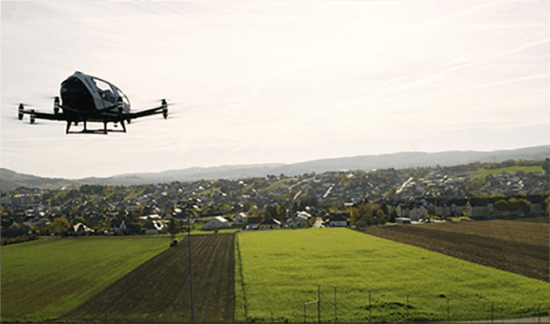
In China, EHang – which was chosen by China’s Civil Aviation Administration (CAAC) as the sole pilot company to develop autonomous flying passenger vehicle services — has already demonstrated flights of its EHang 184 vehicles carrying passengers in Vienna earlier this year.
The company recently announced taking Guangzhou as its first global citywide urban air mobility pilot city and will work with the Guangzhou government to set up a command and control centre to safely manage the autonomous flying vehicles’ movement in the city.
Airbus is also collaborating with the Shenzhen Municipal Commerce Bureau to accelerate and deploy urban air mobility solutions in Shenzhen and China’s Greater Bay area, which covers Shenzhen, Hong Kong, Macau, Guangzhou and seven other cities.
In order for Urban Air Mobility to become a reality, it must be safe and scalable, which means the industry has to overcome significant barriers to adoption and growth. Vertiport infrastructure—the landing and launch pads for eVTOLs—does not yet exist and will be expensive to put in place.
But perhaps most importantly, the traditional air traffic management methods used by manned aviation today are insufficient for the high-frequency, high-density, and high-tempo nature of autonomous vehicles in the low-altitude sky.
Managing air traffic in an Urban Air Mobility environment requires a new infrastructure paradigm. Enter UTM or Unmanned aerial systems Traffic Management.
UTM is a set of digital infrastructure and services that uses high levels of automation to enable UAVs to fly safely in low-altitude airspace. Drone operators currently rely on UTM service providers like AirMap to plan, execute, and glean insights from their flights. The robust UTM infrastructure that supports drone operators today also offers a first step to solving many of the barriers facing UAM, and is what will allow eVTOLs to safely enter low-altitude airspace at scale.
With UTM, operators of eVTOLS and other Unmanned Aerial Vehicles can dynamically plan their routes, taking account of real-time and predicted airspace and environmental conditions. Nearby flights, temporal restrictions, situational obstacles, weather, and vertiport availability are reflected and prioritized in the UTM platform, allowing for highly automated route planning.
Should an eVTOL’s flight path come into conflict with other aircraft operations, its operator can use UTM’s cloud-based computing and information exchange, along with high-bandwidth, high-reliability data links for command and control, in order to deconflict and dynamically re-route the vehicle.
UTM also enables automated vehicle-to-vehicle communication, which can be used for mid-range deconfliction, and complements on-board sense and avoid sensors used for short-range tactical deconfliction as a last resort. These capabilities will ensure that eVTOLs can complete their routes safely, avoid obstacles, and comply with all airspace regulations.
Urban Air Mobility promises numerous benefits in Asia: an airborne alternative to crowded highways, fewer fossil fuel emissions, and the ability to use the airspace to provide emergency services to people in crisis.
The only way to unlock those benefits at scale—to transport people and goods through the low-altitude sky—is with a robust, safety-first, automated air traffic management system designed for autonomous aerial vehicles. UTM provides that critical foundation: it is the bedrock on which Urban Air Mobility will be built; the launchpad for a future of autonomous flight.