





There is a lot of buzz on 5G. Mostly from vendors and mostly to sell new mobile devices and connectivity subscriptions to go with it.
The weird part is that 5G is really meant for the enterprise – at least the vendor and industry pitch. Don’t get me wrong, one of the so-called early applications of 5G is autonomous driving. It’s still in driving with limited pilots running in a few cities around the world.
But the real ROI will come when operators are able to milk 5G’s technical differentiators over 4G LTE: enhanced mobile broadband, massive machine-type communications (IoT) and ultra-reliable and low latency communications. Yes, I am not forgetting network slicing too (the old multiplexing or time slicing).

FutureIoT spoke to Cheang Wai Keat, EY Asean Technology Consulting leader and Singapore head of Advisory, Ernst & Young Advisory to get his perspective on where the industries are with regards to 5G.
This came about because EY published a report titled, Maximizing the 5G opportunity for enterprise, in which the consultancy noted that per the results of a global survey, much still needs to happen for enterprises to really pick up 5G.
How exactly are enterprises in Asia-Pacific looking to tap 5G?
Cheang Wai Keat: According to the study, enterprises are already conscious of the role 5G can play in unlocking new IoT propositions. Globally and for the APAC region, the drivers of IoT spend for enterprises are on improving data management, improving workforce productivity, and generate cost and business efficiencies.
As a result of these key drivers, organizations are considering a range of IoT application scenarios to be delivered by 5G, with the most commonly cited use case being supply chain management and orchestration for 40% of organizations (APAC and global).
The trading sector and high-tech manufacturing customers are experimenting on how to incorporate IoT and 5G technologies into their supply chains to improve delivery timeliness and security. The implementation challenges include the added cost of subscribing to 5G services, on top of the cost of satellite communications and other forms of IoT communications, such as LoRa (or “Long Range”) and Wi-Fi.
Another challenge is managing the power consumption of IoT device under 5G communication. While there are challenges, international freight (sea and air) carriers are pushing ahead with adoption while regional logistics players are banking on broader 5G coverage and new billing model from 5G carriers.
Critical infrastructure monitoring and control is another top use case, with 38% of organizations (APAC and global) identifying it as an application scenario. Government agencies and public transportation sectors are doing advanced experiments on applying 5G, IoT and LoRa technologies to develop solutions for traffic management, crowd control and building management. The main barrier for these use cases is data privacy and data protection risks.
In addition to the above, it is also important for enterprises to consider growth-oriented rationales. In APAC, slightly more organizations are considering growth-oriented use cases such as virtual and augmented reality wearables (APAC 38%, global 35%), as well as personalized products and services (APAC 38%, global 34%).
For example, Korea’s early 5G use cases were in the Telecommunications sector, where applications were developed to provide consumers with a 5G-enhanced immersive sports viewing experience.
How disruptive do enterprises in Asia anticipate 5G as a technology they plan to introduce?
Cheang Wai Keat: Enterprises are aware that 5G can fundamentally reshape their organizations. By entering the very fabric of business processes, 5G can supercharge IoT to deliver the next wave of industrial transformation.
Alongside their interest in exploring 5G’s impact on new business models, organizations foresee the need to overhaul their operating models in a 5G world. Yet this is another potential source of anxiety — while 79% of APAC enterprises (global 74%) agree this is a prerequisite for successful implementation, only 63% of APAC enterprises (global 48%) are confident that their organizations can successfully transition to 5G-based IoT.
There are still implementation uncertainties as enterprises and governments are still at the experimentation stage on the technology integration and application development of 5G. Developing 5G application, in particular, is a brand new area to many software developers as IoT applications are more time-sensitive than traditional internet applications. The issue of data security and data protection is also a key risk to resolve.
The key success factors for 5G applications include: (a) building a foundational 5G transformation agenda, (b) engaging with policymakers and regulators early and often on regulation and supporting policies, (c) reviewing new positioning in fluid and fast-changing industry value chains (d) taking a selective and phased approach to monetizing new use cases in view of ROI consideration i.e., to balance topline growth with the operational costs of data, device, security, applications, 5G, power consumption, and finally (e) building cyber-resilient devices to mitigate data privacy and data security risks.
If they do not intend to implement 5G in the near term, what kind of impact can we anticipate?
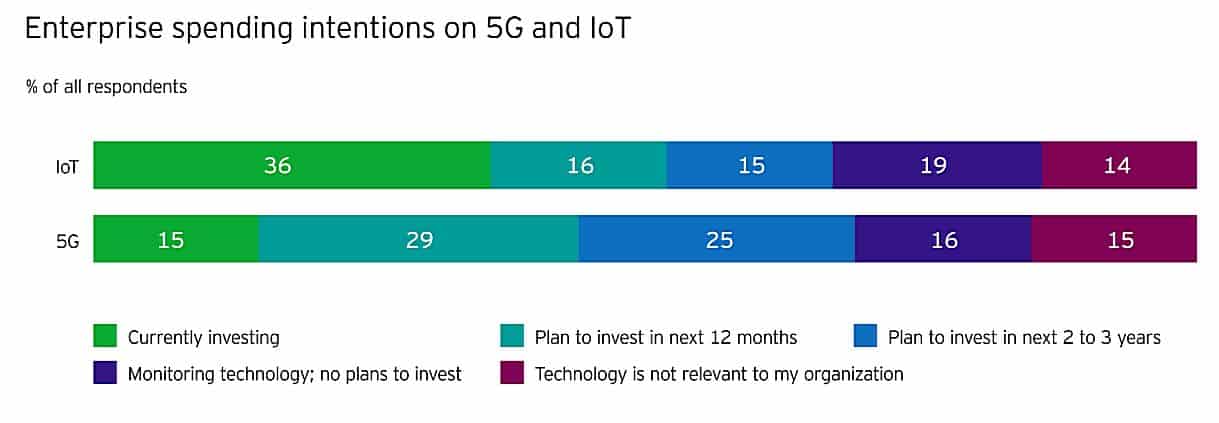
Cheang Wai Keat: 5G is only just now appearing in many markets, but adoption levels will grow substantially in years to come. Currently, 10% of APAC enterprises (global 15%) are investing in 5G, with an additional 51% APAC enterprises (global 54%) planning to invest in the next one to three years. Current levels of investment in 5G and IoT vary among verticals but all industries are preparing to spend on 5G over the next three years.
These enterprises may present more complex business models that are more likely to necessitate a “wait and see” approach. This attitude is largely due to challenges in accurately estimating the return-on-investment (ROI) levels of 5G projects, where organizations are evaluating topline revenue growth and bottom-line improvement against operational costs.
These costs include the operational costs of running IoT networks under the mix of technologies i.e., 5G, satellite, WiFi, LoRa, application development, and also the maintenance and operations of the IoT devices. Given that this is a completely new area, many enterprises and government agencies lack the internal expertise to do financial modelling.
In our view, the stronger push for adoption will be coming from regulated industries such as customs, international shipments, the supply of critical technology equipment to critical public sector applications, transportation, intelligent farming and food safety, and healthcare equipment. For the broader retail industry, 5G will become a replacement of 4G only when the 5G pricing model becomes attractive, and this will take time.