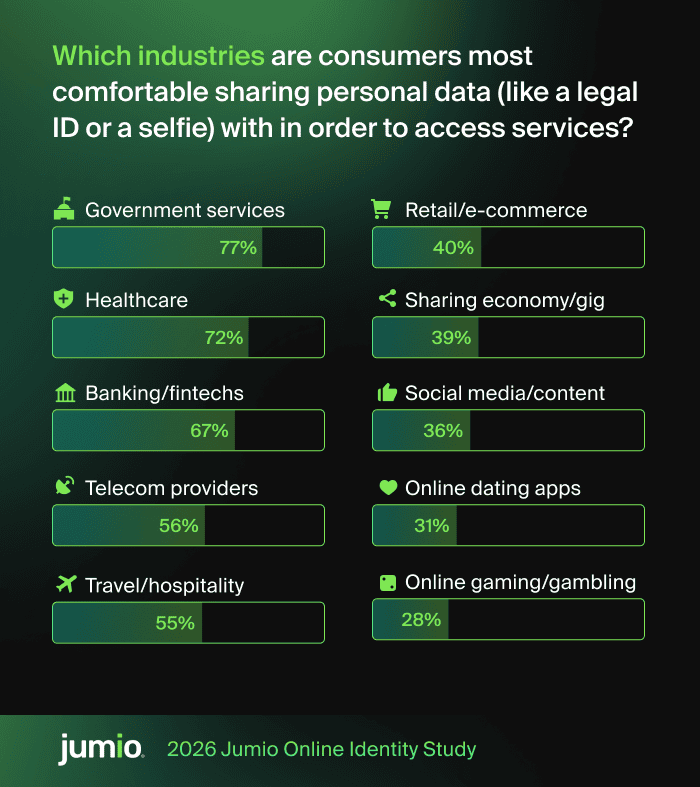
Consumers in Singapore are far more willing to share identity information with government services, healthcare providers and banks than with social media, gig-economy, gaming or dating platforms. The findings of a Jumio online identity study point to a widening trust gap that could shape how digital businesses design identity verification and data-protection practices.
The study found that 77% of Singapore consumers are comfortable sharing personal data, including identity documents and selfies, with government services. Healthcare platforms follow at 72%, while banks and fintechs are at 67%.
Source: Jumio, 2026
Trust gap across sectors
Government services also rank highest for trust in keeping data private and secure, at 77%, followed by banks and fintechs at 66% and healthcare at 55%. By contrast, trust falls to 9% for social media, 5% for the gig economy, and 4% each for online gaming and dating apps.
“Consumers are open to sharing their personal data for verification purposes but they’re becoming more selective about who they trust with that data,” said Joe Kaufmann, global head of privacy and data protection officer at Jumio.
Joe Kauffman
“While highly regulated sectors benefit from established data protection standards, every consumer-facing platform can foster that same level of trust by demonstrating that security doesn’t come at the expense of privacy.” Joe Kaufmann
Fraud exposure remains high
The research suggests that consumer confidence remains fragile amid widespread fraud exposure. Only 44% of respondents in Singapore said neither they nor someone they know has been a victim of online fraud or identity theft.
Age verification trade-off
However, 36% said they would avoid a platform that asks for such information, while 46% said they would choose a less secure or less convenient platform if it meant avoiding identity checks altogether.
Globally, Jumio found that 75% of consumers are willing to verify their age online, while 67% would feel more comfortable sharing proof of eligibility rather than full personal details.
Identity as a trust asset
Jumio argues that secure, privacy-conscious verification can reduce repeated identity checks while protecting sensitive information. Its platform combines biometric authentication, liveness detection, AI-driven risk scoring and identity data sources to support onboarding, fraud prevention and compliance requirements including KYC and AML.
“Consumer trust is becoming a powerful competitive advantage for businesses across every vertical,” said Matt DeLauro, chief revenue officer at Jumio. “Organizations that can verify users seamlessly while safeguarding sensitive personal information will be best positioned to earn consumer trust and build lasting relationships.”