




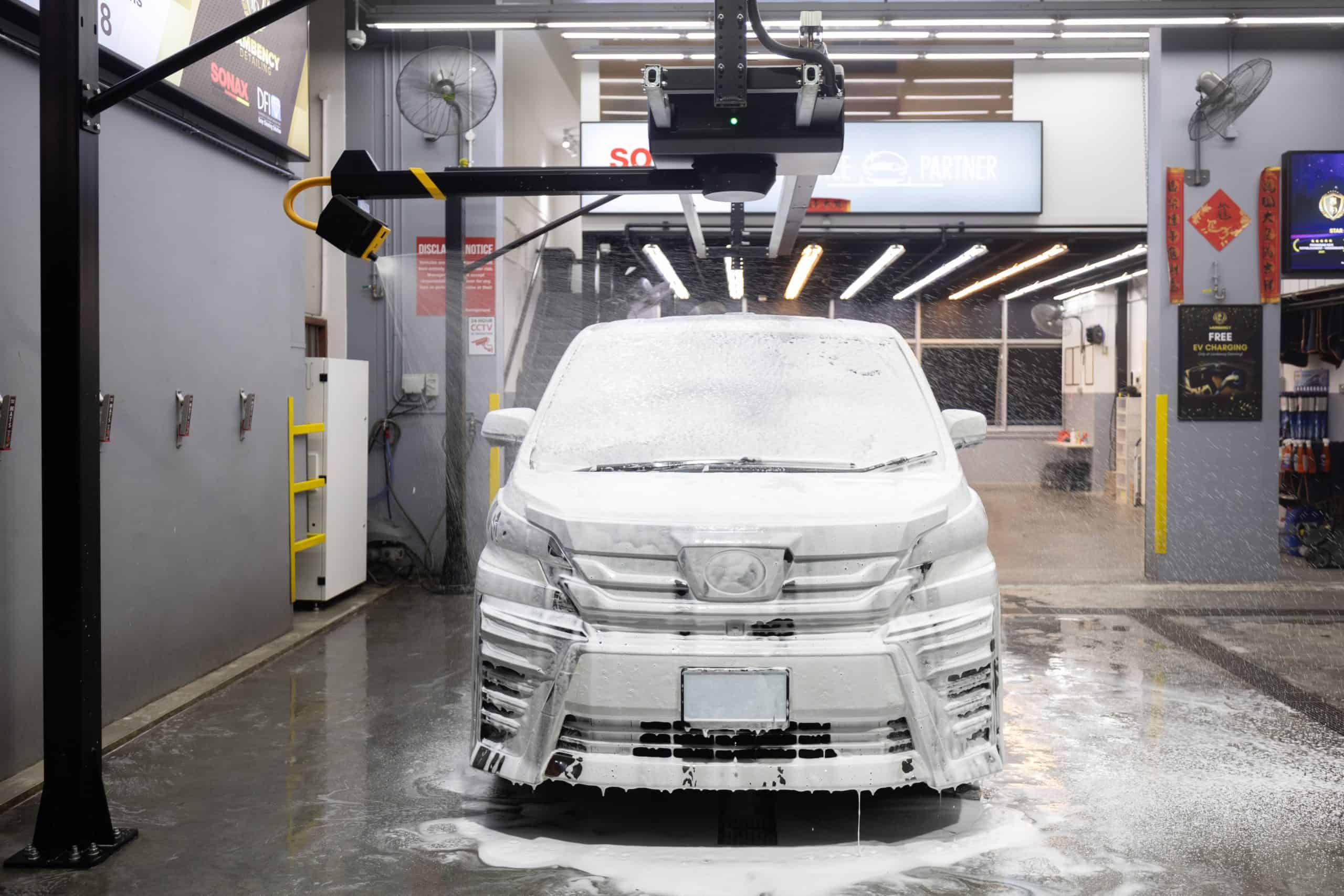
Lambency Detailing has launched Singapore’s first AI-assisted robotic car wash, deploying three robotic units across its Ubi and Bukit Batok outlets. The system automates the foam and rinse stages using computer vision and 3D modelling, while trained detailers continue to hand-wash, dry and inspect every vehicle.
The move illustrates how artificial intelligence is entering Singapore’s small and medium-sized enterprise sector beyond office productivity and customer service.
Robotics meets detailing
Installed in September and refined through trial runs, the robotic units recognise each vehicle’s shape, size and position, plan a cleaning path and adjust rinsing angle and water pressure accordingly. The automated stages are touchless, using only water and foam rather than brushes or cloth strips.
Lambency says the automated stages take roughly half the time of manual foaming and rinsing. The company has kept prices unchanged at S$35 for small to large cars and S$45 for extra-large and exotic vehicles.
“The machine is very good at the parts of a wash that should be the same every time: the foam, the rinse and the coverage,” said Matthew Lim, director of Lambency Detailing. “What it cannot do is notice a stone chip on a bumper or tar spots behind a wheel arch. Our detailers can, and that is why every car still gets a hand wash and two inspections.”
Water and labour efficiency
The manufacturer estimates that the system uses approximately 60 litres of water per vehicle, compared with 100 litres or more for a manual car wash. For a business operating in water-scarce Singapore, that reduction could become a meaningful operational and sustainability advantage as volumes increase.
The deployment also points to a practical model for AI adoption in service businesses: automate repetitive, standardised tasks while retaining human workers for judgement-based work. At Lambency, robots handle repeatable foam and rinse coverage, while staff focus on detecting damage, cleaning hard-to-reach areas and carrying out final quality checks.
Singapore’s AI momentum
Singapore’s wider digital economy reached S$144.1 billion in 2025, equivalent to 19.3% of GDP, according to IMDA. AI adoption rose across all enterprises from 14.7% to 23.5% over the same period, while adoption among larger local enterprises increased from 62.5% to 70.4%.
According to the Infocomm Media Development Authority’s Singapore Digital Economy Report 2026, AI adoption among SMEs rose from 14.5% in 2024 to 23.4% in 2025. It also found that, among firms adopting AI, two in five were either expanding deployment or had fully integrated AI across the company. Workers reported productivity, work-quality and problem-solving improvements, with AI usage rising from 77.6% in 2025 to 85.7% in 2026.