





Southeast Asian companies are investing more in artificial intelligence, but most are struggling to convert pilots into enterprise-wide value. Adobe’s 2026 State of AI Readiness research finds that 57% of organisations in the region are caught in the “Frozen Middle”—piloting or deploying AI without the coordination needed to scale it—while only 6.3% qualify as AI Leaders.
The research concludes that organisational readiness, rather than technology access or spending, is the strongest predictor of whether AI scales.
Investment is not the bottleneck: 73% of Southeast Asian companies are increasing AI spending year on year. Yet 48% are still working on their first AI use case or have stopped after an unsuccessful attempt. Just 15 of every 100 AI ideas reach production, with IT evaluation and security review causing the largest drop-offs.
Adobe found that approximately 36% of AI proposals fail at IT evaluation, while a further 18% are rejected at security review. In highly regulated industries, the security-review rejection rate nearly doubles, reflecting the difficulty of assessing novel AI use cases without pre-approved architectures, standardised security pathways and aligned budgets.
Only 12% of Southeast Asian companies have an AI owner with budget authority, compared with 89% of Leaders. Meanwhile, just 8% measure AI return on investment comprehensively, with most organisations tracking usage rather than output quality, rework or downstream review costs. Skills shortages persist: 81% of businesses said their AI skills gap stayed the same or worsened over the past year.
“As AI investment grows, the gap between experimentation and enterprise-wide value is becoming harder to ignore,” said Jeremy Willmott, senior director, Digital Strategy Group Asia Pacific, Adobe.
“Organisations that establish clear ownership, shared measures of success and stronger collaboration between business and IT will be best placed to move beyond isolated pilots and achieve sustainable impact.” Jeremy Willmott
Adobe’s global research identifies a similar pattern: 58% of organisations are stalled in the Frozen Middle, while only 6% are Leaders. Leaders are 4.7 times more likely to have a formal AI owner with budget authority and achieve 1.4 to 1.6 times greater improvements in cost reduction, cycle time and volume from the same technology.
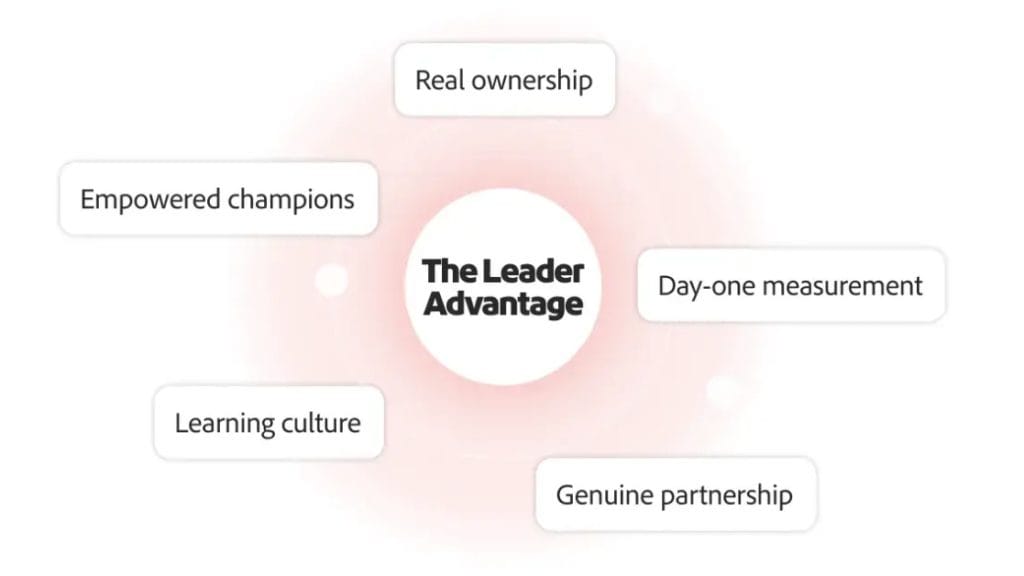
For Southeast Asian enterprises, the lesson is to treat AI readiness as an operating-model transformation. Adobe says Leaders assign accountability, define outcomes and baselines before deployment, bring business and technology teams into joint planning, analyse failure rather than assign blame, and fund internal AI champions.
“The leaders treat the operating model itself as the AI capability—the thing that turns model output into business outcomes,” said Christopher Young, senior director, Global Industry Strategy at Adobe.