






Call centre, customer-service and information and communication technology (ICT) roles have become among the fastest-growing targets for job scams across Asia, according to analysis by Jobstreet by SEEK’s Trust & Safety team.
The company removed nearly 11,000 high-risk job advertisements across eight Asia-Pacific markets between July 2025 and June 2026, after scanning millions of listings.
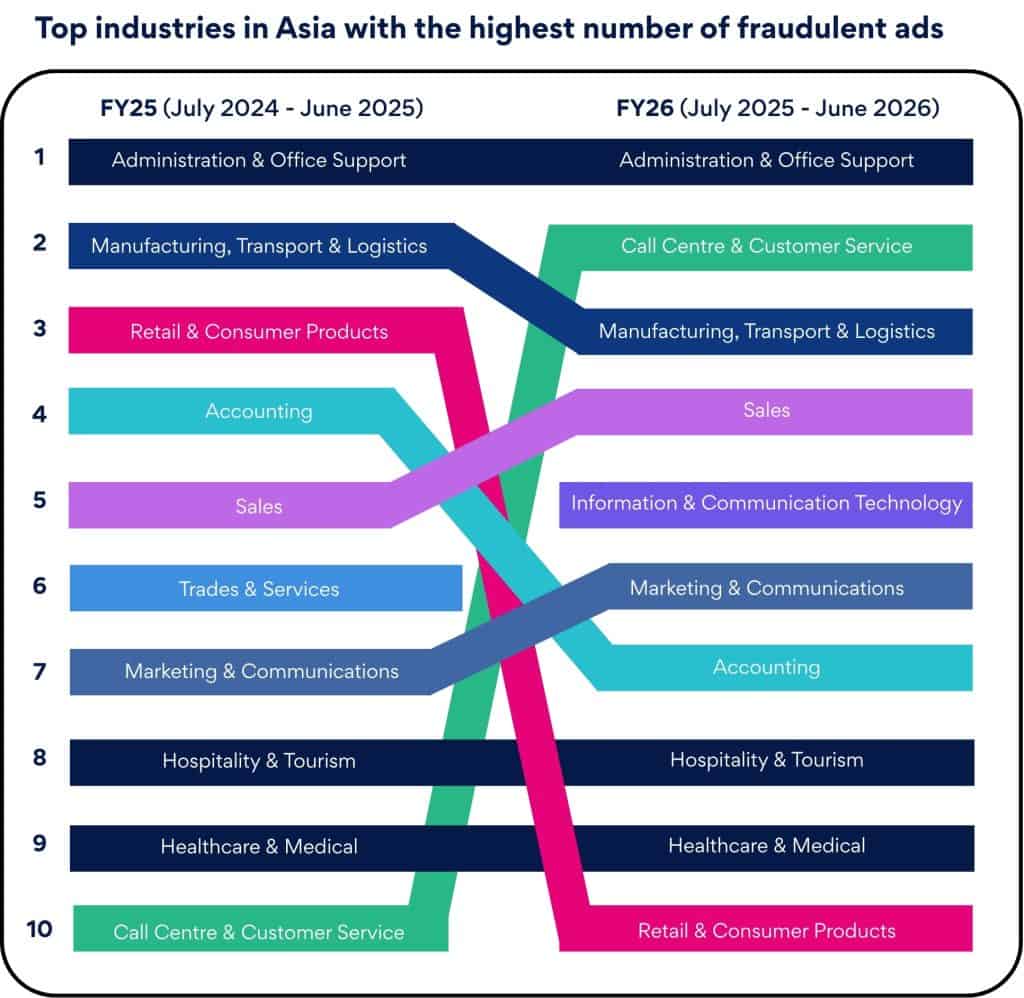
Although the removed advertisements represented only about 0.2% of all job ads, SEEK said the figure reflects a notable increase in detection activity as fraud tactics evolve. Administration & Office Support remained the most targeted industry for a second consecutive year, accounting for 17.7% of fraudulent advertisements.
Shift towards service and technology roles
Call Centre & Customer Service rose from tenth to second place, accounting for 16.6% of fraudulent advertisements. The volume of such ads more than quadrupled year on year. Information & Communication Technology moved from thirteenth to fifth place.

“Scammers tend to gravitate toward customer-facing or tech roles like customer service, technical support and IT, often because these jobs can be dressed up to look highly credible, with attractive pay and flexible requirements,” said Tom Rhind, head of Trust & Safety at SEEK.
He added that administration and office-support roles face a similar pattern because they are among the most advertised jobs in the market.
“These roles, along with other entry-level positions, create larger pools of potential applicants, making it easier for scammers to cast wide nets with convincing-looking opportunities,” Rhind said.
Onsite roles dominate
Contrary to the common assumption that job scams are mainly linked to remote work, almost three-quarters of fraudulent advertisements in Asia that specified a work arrangement were for onsite roles. Hybrid roles accounted for 15%, while remote roles represented just 11%.
In Singapore, 43% of fraudulent advertisements were for onsite positions, compared with 31% for hybrid roles and 26% for remote roles. The Philippines recorded the highest volume of remote fraud advertisements in the region, although remote roles still made up only 20.7% of fraud advertisements there, with 75.3% linked to onsite roles.
Thailand was the only market where remote roles outnumbered onsite roles among fraudulent advertisements, with remote positions accounting for 46.3% of cases.
“People often assume job scams are mainly associated with remote work, but our analysis shows that’s not necessarily the case,” Rhind said. “A job’s work arrangement alone doesn’t tell you whether an opportunity is genuine, which is why it’s important for job seekers to stay alert regardless of how a role is advertised.”
Platform safeguards
Jobstreet by SEEK said every hirer is verified before their first advertisement goes live, while its systems scan all job advertisements before they reach candidates and flag those requiring closer review. The company also relies on candidate reports to identify scams that move conversations off-platform, often through unsolicited emails, phone calls or WhatsApp messages requesting personal information or payment.
“We have strong measures in place to stop bad actors before their ads even reach a job seeker, however some only reveal themselves once they move the conversation off-platform,” Rhind said. “We’re committed to keeping job seekers informed, and we always encourage anyone who sees something that feels off to report it.”