




There is a familiar joke in utility boardrooms: the organisation has spent years collecting data, only to discover that the hardest part is not gathering it—it is getting someone in the control room to act on it before the next outage, heatwave or unexpected surge in demand.
Itron’s latest research suggests that moment of reckoning has arrived. Its 2026 Resourcefulness Report finds that 93% of utilities say major data and intelligence investments have already enabled at least two use cases beyond their original purpose, with 47% reporting four or more. In other words, the smart-metering and grid-analytics investments once justified for billing or outage detection are quietly becoming multi-purpose operational assets.
For Asia-Pacific utilities, the timing could hardly be more consequential. The International Energy Agency expects India and Southeast Asia to account for a substantially larger share of electricity-demand growth among emerging economies by 2030, driven by economic expansion and rising air-conditioning use that will lift both annual consumption and peak loads.
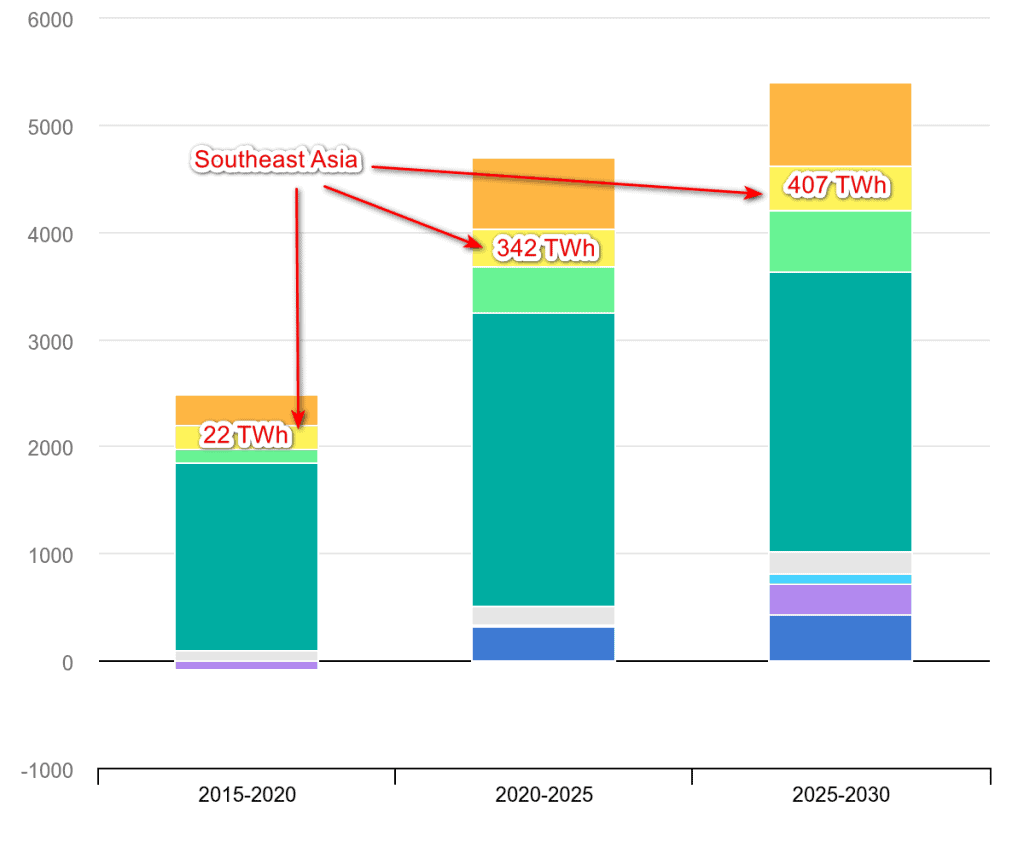
The IEA also estimates that meeting forecast demand through 2030 would require annual grid investment to rise by roughly 50% from today’s US$400 billion.
That is the uncomfortable arithmetic facing regional operators: demand is arriving faster than wires, substations and traditional planning cycles can comfortably accommodate. Data intelligence will not replace capital investment, but it can help utilities squeeze more capability from the assets they already own.
The report identifies load growth as the top grid stressor, cited by 43% of respondents, ahead of rising customer expectations at 36%. In Asia, those pressures are compounded by electrification, distributed solar, electric vehicles and, increasingly, data centres.
The IEA notes that AI infrastructure can be deployed in one to two years, while grid upgrades often take five to ten—leaving utilities with a narrow window in which operational intelligence must do some of the heavy lifting.investors.
There are already signs of practical progress. Itron has made its Riva IEC grid-edge meters available in Australia, New Zealand and Singapore, positioning them as both sensors and control points for distributed energy resources.
In Thailand, the Provincial Electricity Authority has deployed Itron-enabled advanced metering in Pattaya as a step towards a broader national AMI programme. Indonesia’s PLN has also used Itron smart-payment meters to support electrification and revenue protection.investors.
Yet the report’s central warning is that intelligence remains underused. Although 86% of utilities use AMI data enterprise-wide or in specific workflows, only 41% say it is fully embedded and scalable across daily operations. Technical integration is the leading barrier at 53%, followed by lack of automation at 47% and data quality at 44%.

“Utilities have made tremendous progress building the data and intelligence capabilities they need to manage an increasingly complex grid,” said Marina Donovan, vice president of global marketing, ESG and public affairs at Itron.
“As load growth and other pressures accelerate, the opportunity now is to connect that intelligence to the decisions utilities make every day.” Marina Donovan
For Asia-Pacific chief operating officers, the lesson is refreshingly unglamorous: stop treating analytics as a dashboard and start treating it as an operating discipline. The next competitive advantage will belong to utilities that can turn grid-edge signals into faster outage restoration, predictive maintenance, peak-load management and better customer outcomes—without waiting for a new substation to save the day.