




More than half of organisations expect AI to make or execute more than a quarter of their operational warehouse decisions autonomously by 2028, according to a global study by the Intelligent Logistics Systems Lab at MIT’s Center for Transportation & Logistics and Mecalux. The research also finds that 90% expect to increase AI investment over the next two to three years.
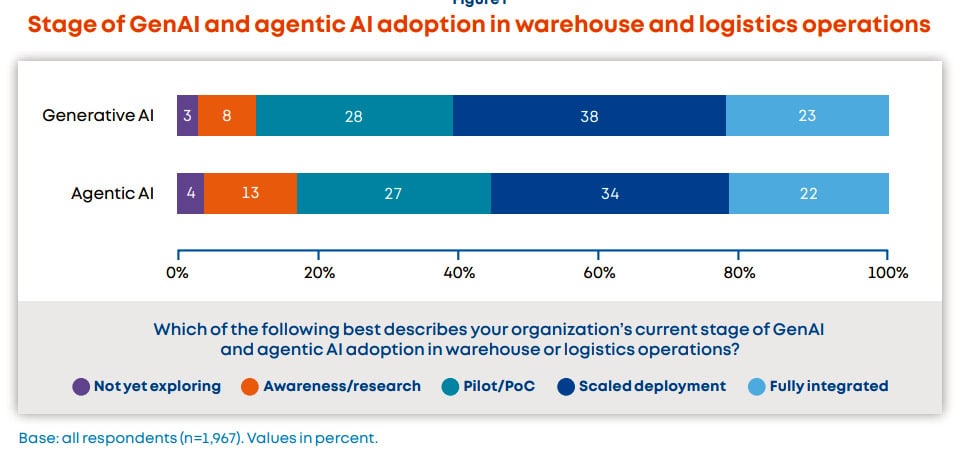
The report, The State of Generative and Agentic AI in Warehouse Operations, finds that adoption is already widespread. Sixty-one per cent of organisations report generative AI (GenAI) at large-scale deployment or full integration, while 56% report the same for agentic AI. However, around three in four applications have been at their current deployment stage for less than a year.
Value is emerging, but not fully measured
Among use cases described in detail, 87% of GenAI and 81% of agentic AI applications showed at least moderate improvement in their target metrics. Yet only 39% of GenAI and 36% of agentic AI use cases had significant gains that were quantified and documented. Where respondents could estimate the gain, the typical improvement was around 20% on the main target metric.
“The objective is to move beyond general sentiment and to provide practical guidance on where these technologies are delivering operational value today and where they remain experimental,” said Matthias Winkenbach, Director of the Intelligent Logistics Systems Lab.
Autonomy within limits
Companies are granting AI agents meaningful authority, but mostly within defined boundaries. Agents most commonly make decisions without human approval on inventory movements, in 51% of agentic use cases, and data corrections, in 42%. By contrast, only 22% can make customer-facing commitments and 12% can make financial decisions.
The most common oversight model is “human-on-the-loop”, in which AI operates within limits while employees monitor performance and can intervene.
Governance separates leaders
The study finds that governance and systems integration are associated with stronger results. Organisations with comprehensive, actively enforced AI governance are about twice as likely to report significant, documented improvements: 51% versus 26% for GenAI, and 46% versus 23% for agentic AI. The report notes that this reflects association rather than proof of causation.
Legacy-system integration remains the principal barrier to scaling GenAI, cited by 40% of respondents. A further 54% say better integration with warehouse management and ERP systems would have the greatest impact on accelerating adoption.
Investment and workforce shift
Nearly a third of organisations, 29%, expect to raise AI investment by more than 25% over the next two to three years. Among companies that have fully integrated these technologies, 70% expect agentic AI to autonomously make or execute more than a quarter of operational warehouse decisions by 2028, compared with 57% overall.
The research suggests AI is changing warehouse roles more than eliminating them. Fifty-six per cent of organisations say AI has mainly shifted employees towards higher-value tasks, while 11% report reduced headcount and 9% report increased headcount. Seventy-three per cent are upskilling warehouse-floor staff, and 61% are creating new technical roles.
“Warehouse decision-makers need AI they can measure,” said Javier Carrillo, CEO of Mecalux. “This research gives our clients a clear map of where the technology is working today and what it takes to prove it.”