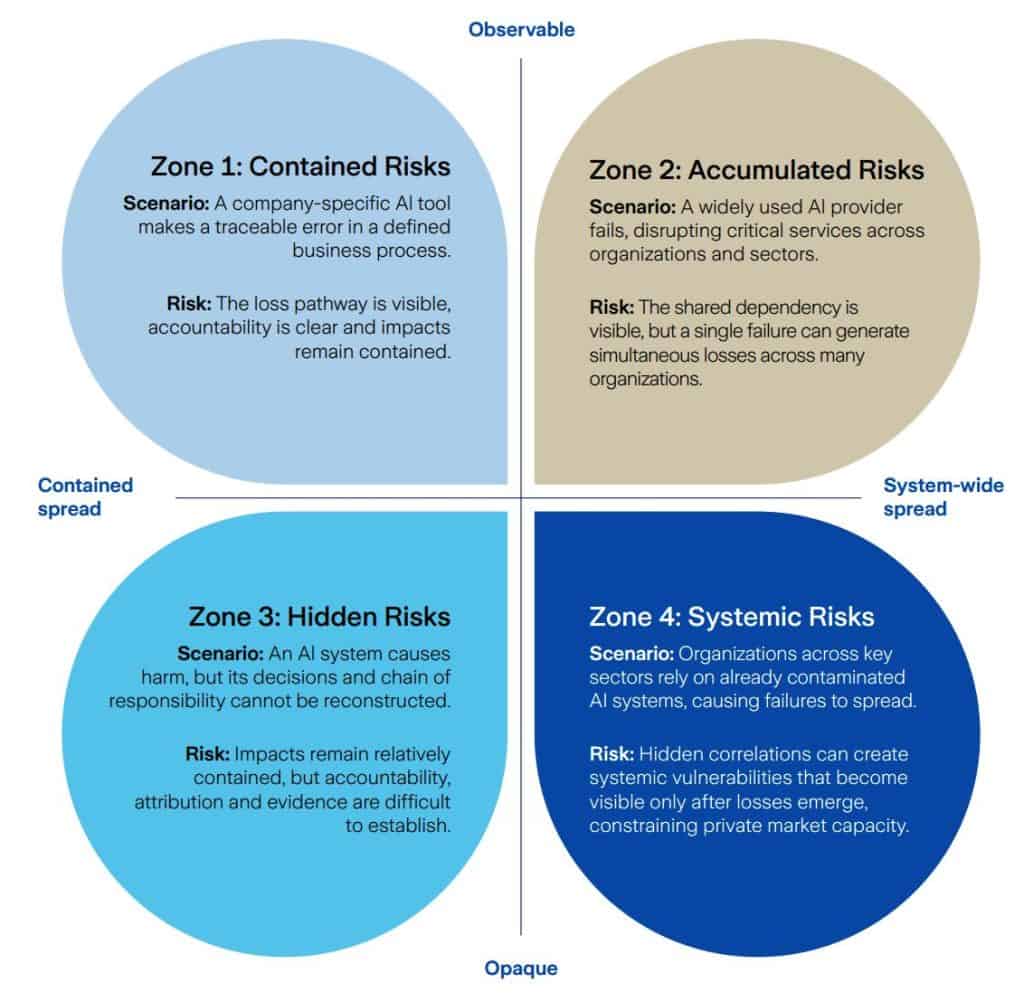
AI systems that appear independent may share hidden weaknesses, allowing operational and financial losses to spread across organisations and sectors, according to new research from Zurich Insurance Group and the University of St. Gallen.
Source: The AI Resilience Challenge – Keeping AI-related Risk Manageable, Zurich Insurance Group
“AI will transform business. The opportunity is enormous, but we also need to understand the risks,” said Mario Greco, group chief executive officer, Zurich Insurance Group.
Hidden risk connections
The study identifies two mechanisms through which AI-related losses can propagate: concentration and correlation.
Concentration occurs when organisations rely on the same AI providers, models or infrastructure, meaning one disruption can affect many businesses simultaneously.
Correlation is less visible: apparently separate systems may use similar data, architecture, decision logic or behavioural patterns, causing them to fail in comparable ways even without a shared provider or outage.
The report warns that organisations may believe they have diversified their AI exposure while remaining vulnerable to common weaknesses.
Connections may only become apparent through claims, complaints, regulatory action or litigation across otherwise unrelated organisations.
Mapping the risk landscape
The study maps AI-related risks into four zones, according to how well they are understood and how far losses could spread. At one end are relatively well-understood and contained risks; at the other are systemic risks, where potentially widespread losses combine with connections or loss pathways that are difficult to identify or quantify in advance.
Risks can move between zones. Wider adoption and greater concentration can increase exposure, while better evidence, clearer accountability, stronger controls, diversification and tested recovery capabilities can make risks more manageable.
Building resilience
The report recommends that organisations map AI use and dependencies beyond immediate suppliers, assign clear accountability and set limits on what AI systems may do.
Mario Greco
“Companies need to know where they depend on AI, what can happen when it fails, and be prepared to respond and recover quickly.” Mario Greco
Businesses should also test whether they can maintain critical activities, override AI decisions or switch to alternatives during disruption.
The findings are timely as AI becomes embedded in everyday operations and increases reliance on shared models, cloud platforms and data pipelines.
The report argues that insurability offers a practical test of whether AI risk remains manageable: risks are easier to insure when exposures can be identified and measured, losses are bounded, responsibility is clear and exposures can be diversified.
Concentration, hidden correlation and unclear accountability weaken those conditions. Insurers can use a portfolio-wide view to identify shared dependencies and emerging loss patterns that individual firms may not detect, while changes in coverage, terms, capacity or information requirements can signal that exposure is outpacing evidence and controls.
Karolin Frankerberger
“AI is becoming part of how almost every company operates,” added Professor Dr Karolin Frankenberger of the University of St. Gallen. “The challenge now is not simply to innovate faster, but to build systems we understand, can trust and can recover when they fail. That resilience will be critical to economies and societies.”